Sunday, December 29, 2013

RIS 2013 Day 2 - Review

There is a reason RIS is for younger people. The last session ended last night at 11 pm. I skipped the entertainment portion and reached home at about midnight. It took me about half an hour to transcribe the notes and then some more to format it properly for the blog. By the time I was ready for bed, it was 1.30 in the morning. And then I had to get up for Fajr (no use reviving the Islamic spirit if you are asleep for Fajr, is it?); and here I was, 10 am, already downtown at the convention centre, ready for Day 2.

A talk by Ustadh Abd al-Karim Yahya on taking care of our souls got us underway. We learnt how the Prophet pbuh used to pray for his ummah, and he told us to pray in the wee hours of the morning. Our religion should help us connect with others and also pray for others. We should be a people who summons others and engage with others. We have to take our strongest concern to Allah, and then the strongest concern of others to Allah. He gave us a touching personal anecdote of how he prayed for his own mother to come to Islam.

He was followed by sister Yasmin Mogahed who continued her good form from yesterday, speaking on the same topic. Highlights included
-          Islam has come to free you from the servitude of man and make you a servant of Allah alone.
-          Freedom is not where you are free to do anything you want. That is when you are a slave to your nafs. True freedom is where you can be free from your nafs.
-          She talked about Qalbun Salim and how a Muslim is like a bird whose head is the love of Allah (without the head the bird will not survive). The two wings are fear and hope. The fear of Allah keeps us on the straight path and the hope of His forgiveness makes us do good. When the two are in balance the bird is in flight.
-          Islam is not a club of perfect people but people trying to do the right thing who will slip up at times.
-          Someone asked the Prophet pbuh how to get Allah to love him AND how to get the people to love him. He replied that you must have zuhd (detachment from the world: defined by Ali as not that you do not own anything, but that nothing owns you) so that Allah loves you and you have zuhd in what people have and people will love you.
-          The more you run after duniya the more it will run away from you and the more you run after Allah, He will put the akhirah and duniya in your lap. This is where I wished she would have given the stories of some of the earlier Sahabah who didn’t care about this world but only of Islam, and Allah put the world at their feet.
-          She talked of the verse 3:189-190 “Indeed, in the creation of the heavens and the earth and the alternation of the night and the day are signs for those of understanding. Who remember Allah while standing or sitting or [lying] on their sides and give thought to the creation of the heavens and the earth, [saying], "Our Lord, You did not create this aimlessly; exalted are You [above such a thing]; then protect us from the punishment of the Fire.” – that if we ponder on the creation of this world we will come to the understanding that there is a purpose to its existence and to our existence.


The next session was by Dr Seyyed Nasr on sacred sciences.  What is sacred science? Dr Nasr started by saying the word science has very limited meaning in the English language but other languages describe it better. In French science also includes moral sciences and in German it means organized knowledge. The Arabic world “ilm” is most complete in this regard, and the Arabic world Al Alim is an attribute of Allah. Dr Nasr reiterated that science without God is a bidah and how secularization of knowledge is a modern phenomenon (this theme would be touched upon again by Shiekh Hamza Yusuf later in the evening). He pointed out that ancient civilizations built wonderful scientific monuments (such as a damn in Sana or the pyramids) but didn’t cause an environmental crisis because they didn’t divorce the divine from science. The goal of science used to be wisdom but today it is power (remember, knowledge is …?). Modern science limits itself to quantitative elements. Islamic science was great and Islam doesn’t have the conflict with science that Christianity has because in Islam science is not an alternative to God but a way to understand Him better.
It was a great talk, and he had lots of examples – for example how Ibn Sina when stuck on a scientific problem went to the mosque and prayed, and how Al Haitham the father of optics used to have “Allah is the Light of the Heavens and Earth” in his lab, but at the end of it I had two questions that I didn’t get answered – perhaps this was good because a good talk whets the appetite so you can do your own follow up. My questions were:
What exactly IS sacred science? Is it just putting God in science?
And how do you practice scientific research differently in that case?

The following session was by Dr John Esposito. It was titled Get Up! Stand Up for your Rights! Now before I recap his talk I have to offer a criticism. His talk was very American. It was focused on US and US examples. Now while what happens in the USA does impact Canada, some of it is not the same. While 9-11 affected everyone, the Park 51 circus was a non factor here. We have our own issues (Quebec hijab laws) that should have been talked about. The talk should have focused on what we can do in Canada. Even some of the complaints about not having enough presence in the public square, the media examples (Huffington Post) - it was all about USA. Amongst the problems in Canada he could have mentioned Tarek Fatah and his ilk (the MCC). Another criticism of his talk was that he asked us to plug into the establishment way of doing things and to be involved with the movers and shakers and the levers of power, but he didn’t put any qualifications or restrictions here. Perhaps it was due to time.
He talked about the immigrant experience and how an immigrant group moves from other to being accepted. Muslims were on that path when 9-11 happened. We have to have greater media presence and contribute financially to organizations like CAIR and so on, and how we must avoid segmentation within ourselves.

He was followed by sister Dalia Mogahed on the same topic and she confirmed that yes, she is indeed the sister of Yasmin Mogahed. I LOVED her talk. She started by saying that Western societies are looking at Muslims like a tumor. They are wondering whether it is a benign tumor that is harmless, or a cancerous harmful one that should be removed. And muslims are saying we are harmless, harmless! No! Muslims should stand up and say we are a vital organ of the body and remove us, the body will wither and die. She then used the first verses ofSurah Muddassir to show how it is a guide to social activism.

O you who covers himself [with a garment].
Social activism and public work is a calling that you do because you have it in you – you don’t do it for fame or ambition or worldly benefits. It will put us out of our comfort zone
Arise and warn.
We have to rise and deliver the warning. We are not told to make everyone Muslim. That is not the aim. We have to divorce ourselves from the results – we will not be asked about the results. We will be asked whether we delivered the mail, not whether others read them.
And your Lord glorify.
Our work is for God alone. We should never let the ends justify the means. Our work is a way to achieve God’s pleasure. Don’t do it half hearted.

And your clothing purify.
And uncleanness avoid.
And do not confer favor to acquire more.
Do everything in the halal way and never be focused on just the results. Try to do it halal and Allah will give you barakah. Here I wished she drew on early history of the Sahabah and how they conquered the world with limited resources.

But for your Lord be patient.
Anyone in the public square will face brickbats and slander and hatred. They have to be patient.


Sheikh Mokhtar Maghraoui led the following session titled Light in the Midst of Darkness: Prophetic Guidance in Troubled Times. He said Allah has made both darkness and light and He is Light and all Light comes from Him, so if we want that Light, we have to come near him. Hardships can bring a mumin closer to Allah (no pain, no gain). We have to pray, salah, do zikr and prostrate to Him more often.
I skipped the following session for an extended bazaar break. So here’s my review of the bazaar.


It was TOO crowded. Now I haven’t been to RIS in the last few years so I don’t know if this was par for the course but it was packed and especially during the breaks it was really hard to move around (good practice for Hajj, I kept saying to myself). Moreover, there were only limited dining tables in the dining area (they were large and occupied by families all the time). Young people were eating by sitting on the floor outside the convention halls. My father and mother are senior folk who can’t sit on the floor due to bad knees, so I had to wait a while before we could find a free table (and it was a melee to get one!). So my advice to RIS would be to enlarge the dining area and get more tables there.


The bazaar wasn’t anything different. There were lots of books and bookstores had a large presence, along with the regular hijab, oudh and Islamic arts stuff. Overall the bazaar area seemed kind of small for me this time. Hamza, a character from a children’s series, made an appearance and was popular with kids. Eastern Toybox was another unique stall. Dawahnet and Soundvision too had their large presence (and they do a lot of good work in the community).


Back to RIS talks (it was now post dinner and the talks would be back to back). The next session I attended was Aspirations of a Believer by Sheikh Zahir Mahmood. He talked about how death was the end of all aspirations, and we all have to face death one day. The Prophet pbuh was one person who actually finished his work before his time was up, so we Muslims have to follow his example. We have to have aspirations and goals and have specific goals and ambitions. The Prophet pbuh gave the Sahaba aspirations and they conquered the world. For our life, we need visions, aspirations and goals. People with low aspirations will justify their life to themselves rather than try to improve it. Even in our prayers, for example, we have to ask for Jannatul Firdaus (2nd best not good enough for Muslims). Too many muslims say they are ready to die for Islam, but they are not ready to live as Muslims. They should be focused on making society better, and their focus should start here, where they live. If today all the muslims of the world disappear, will anyone miss us?
He then concluded by that famous story of the three men stuck in a cave. Each man recounted a deed he did for the pleasure of Allah alone, and the covering rock of the cave moved a little. The first one recounted how he spent the whole night with a glass of milk in his hands waiting for his parents to wake up, the second one said how he avoided zina with his cousin, and the third one said how he gave the amanah of an employee back after years (with all resulting investments). The sheikh than asked us, if we were the fourth person in that cave, would we have any story to share?
He was followed by everyone’s (and my) favourite – Nouman Ali Khan. He actually had the audience stand up and stretch, and then facilitated a shahadah, before going on to his topic of Marriage. Key points include (with lots of humour thrown in):
-          Muslims in the west become isolated and the mosques where we meet people of different ethnicities we don’t spend a lot of time there, so we don’t get to know one another, especially for marriage and love.
-          Youth need to talk to their parents about marriage and their preferences.
-          Girls go on long academic tracks and the reality is they go past a cultural “expiration date” and have trouble getting married.
-          Parents are here, kids are here, no one is going BACK home. We don’t have a lot to pick from, so we shouldn’t judge a suitor by ethnicity.
-          The land isn’t perfect and is full of shamelessness of the worst kind.
-          Some people keep shooting down proposals because they are not perfect yet don’t see themselves in that light.
-          In desi culture your son is your retirement plan, so a girl is brought into the family as a “servant” and parents don’t look for an “intelligent girl” as she will mess up the insurance plan, and oppression happens in the house.
-          Youth, when you prematurely give your heart to someone, a heart which is a special gift of Allah, it has a spiritual impact. Don’t do it.
-          It’s OK to look for a spouse, but take a respective, responsible approach. The indirect approach is the best as satan gets involved when you get involved directly (late night text messages, flirting beyond control, skype sessions). Get to know someone, but get others involved. Deal with reality instead of cursing it.
-          There are two sides: the youth have to get more strict and the parents have to get less strict when it comes to marriage.
-          In Islam parents have to be obeyed, but they also have to be fair and just.
-          For guys, BE A MAN.
-          Ustadh Nouman Ali Khan shared that he himself got married at the age of 22.

The following session was by Ambassador Shahbazz and Tariq Ramadan on coexisting and behaving well with the “other”. I am summarizing Professor Ramadan’s speech below:
-          You don’t have to respect what someone does (his actions) but you can respect that person as an individual.
-          All the messengers could go to their people and say “Ya qawmi” – they were concerned about their people, even if they were mushriqs.
-          We are all neighbours in humanity.
-          About Nelson Mandela. Let’s take and learn from the good in his life. He was courageous and brave and didn’t sell his soul and forgave his enemies. As for his after life, we leave it to Allah and we remain silent on it.
-          We cannot isolate ourselves but must integrate in the society. We love everyone, but we love the justice in them and we oppose the bad they do.
-          Muslims must be the voice of the voiceless and they must stand up against oppression even if the victims are not Muslims, for example native rights here in North America. He brought up the example of Hilful Fudul from the seerah.

There was a nasheed performance by Outlandish, and I really enjoyed their track of Aisha.
There was also an address in video by the leader of the Liberal Party of Canada, Justin Trudeau.

 
The best talk of the night was the last one – entitled When Worlds Wither: Guidance in the Latter Days by Sheikh Hamza Yusuf. If you could see one talk today, you should see this. I would urge everyone to buy a DVD or CD of this talk if you can.

He stated by asking us to pray for his mother who is 93 (he made a point that she was born when there was still a Caliphate). Sheikh Hamza Yusuf actually had a presentation on his topic that he incorporated into his talk. Again, I must stress that this recap will not do an iota of justice to his speech, it’s a speech about how we are raving our planet that should be read at the United Nations. I was so engrossed in the talk that I actually wasn’t taking notes as I should, so these are from memory as well. Again, PLEASE BUY THIS LECTURE.
Man is doing fasad (mischief) on earth when he is supposed to be its caretaker (caliph). The corruption is on land and sea and the sins of man have an effect on the sea.

Corruption has appeared throughout the land and sea by [reason of] what the hands of people have earned so He may let them taste part of [the consequence of] what they have done that perhaps they will return [to righteousness].” Quran 30:41.
The corruption in the ocean has resulted in fish diminishing due to our sins (and the sheikh was supported by statistics and facts). Fires are spreading across the earth and as global temperatures go up so do fires. 15,000 people died due to terrorist acts and we have a war on terror, but 1.5 million people died due to pollution and bad air yet we do nothing about it.

The Quran tells us the animals are communities like us and have equal rights to earth, yet we don’t care about them. Dogs are now getting depressed because they live with people who are depressed and this is not a natural order of things. The powerful animals (lions, tigers, elephants etc.) are on an endangered list and the cockroaches and rats are not. And humans are now aping cockroaches and rats in our behaviour and leaving aside the lions and tigers. The ocean is getting more acidic and the star fish are dying and as corruption spreads to the sea, 90% of big fish stocks have fallen (90%!!).

What is increasing? Jelly fish. They are spineless, mindless and consume all the time – just like us humans today.

In all facts and figures he was presenting credible sources and news articles. He talked about usury and the uncontrolled growth and the “war of Allah” that is coming (and it’s not just in the hereafter) the banking industry has been close to collapse and Allah WILL bring it down. The rulers in power are making billions from war when the average people have no hatred between them naturally.

As I said, it was a very powerful talk that deserves to be seen, not just read as a recap from some blog.
So that was Day 2. A very good day with lots of great speeches.


Saturday, December 28, 2013

RIS 2013 Day 1 - Review

RIS stands for Reviving the Islamic Spirit convention, one of the largest of its kind in the world. I haven't attended the convention for the last few years, so this year I decided to return in a long while and see what I have been missing. The Toronto Metro convention is a convenient place to hold the event - it's right downtown and there's parking (expensive at $27/day!) nearby.

The first thing I noticed was that they were still doing the bands thing. You register and pick up your conference stuff (a name tag and a wrist band) and the problem is that you have to wear the wrist band for three days. You can't cut it or take it off. Now I don't know about you but I feel very uncomfortable sleeping while wearing a wrist band. Minor complaints though ...

First up was the Friday sermon by Ustadh Nouman Ali Khan, one of my favourite speakers, and he didn't disappoint. There are many verses that tell us "don't do this" or "don't do that", he said, but there's some rare ones when Allah tells us in very strong terms, "stay away from this", rather than merely "do not do this". This was in Surah Hujarat where Allah is telling us to stay away from making bad assumptions about other people, or "Zan". It was a good khutbah with lots of examples, but what was sad was that when I heard the sisters could not hear the talk at all due to sound / technical issues, so all they heard was echo. I hope it's something they keep in mind for next year.


The first proper session was a talk on The Sanctuary of God's Book. It was delivered in two segments, first by Ali Ataie, and second by Dr Badawi. Now I enjoyed Ustadh Ataie's talk immensely - it was full of passion and examples and humour in proper doses. Highlights included:
  • holding tightly to the rope of Allah
  • The Quran is the rope of Allah, hold on tight as if your life depends on it, and a parable is the umbilical cord from the mother to the fetus in the womb
  • The Neyamah (blessing) is the holy Prophet Muhammad (pbuh)
  • As per the Deists, God is not man and cannot love man, and vice versa, therefore God became man in the form of Christ. This isn't what Islam says, obviously. God loves man despite being spaceless and timeless and doesn't have to mix in with space and time to love man.
  • Quran 21:107 is the equivalent of Bible's John 3:16, and also Quran 3:31.
  • Jesus was asked the secret of walking on water. He asked his disciples which was more valuable - gold, stone or mud. They ranked them in that order. He replied that to me, all are same. And when you figure that out, you will know how to walk on water.
  • Don't waste life on simply bread and entertainment. Take solace in the Quran.
  • Just because you are a Muslim you are already better off. In any predicament, it could be worse. It's in your duniya, not akhirah and with every difficulty comes ease.
The next session was on patience by Sheikh Mokhtar Maghraoui and he talked about how our original home is Jannah and we have to return there. Allah rules this world by rahmah and not justice (in which case we would all be doomed as we sin a lot) and we need patience to be loving and fair. He asked us to remember how patient is Allah with us when we misuse His blessings to do things He doesn't like, and so be patient with those under us. My person nasihah to the sheikh would be to speak up a bit. He is very soft spoken, so it was hard to hear him from all the way in the back, even with the microphone and modern technology.


The next session was the second best session of the day, and it was by Sister Yasmin Mogahed on Pain and Suffering and Tests. Are you noticing a theme here? :-) It was simply a really well thought out speech and a fantastic presentation and on this evidence RIS should definitely get more female speakers - she and Nouman Ali were the highlights of the day for me. Here's the key points from her talk:
  • How do you respond to a trial? Is it a blessing or a punishment? People usually respond one of three ways.
  • First is to complain about God and be angry at God. Why me? Obviously we don't want to do this as Muslims.
  • Second is to be patient despite our hurt and refrain from complaining about Allah, but rather complain to Allah (examples are the Prophet pbuh's dua after the humiliation of Taif, Yusus pbuh's dua from inside the belly of the whale. You admit your own weakness and ask Allah for help. It also removes the sins of the believer.
  • The final is "rida" - this is the highest level where you are content with whatever Allah gives you, and it elevates your status with Allah.
  • The example of the three are a newborn who is to get an injection and doesn't understand that it's good for him, so he cries and is angry at the doctor. Later on, as a child he understands it's good for him so he bears through the pain. Finally, as an adult, even when put under a surgeon's knife, he trusts the doctor and is happy that such a good doctor is taking care of him. No matter what happens to a believer, it's good for him (or her).
  • It's not like an exam of this world where you are not allowed to cheat or ask for help, but rather, DO ask Allah for help in a test. And remember the difference between Adam and Iblis when they both made a mistake and slipped up - Adam asked Allah for forgiveness in humility.
  • There will be no fear or sadness in Paradise, and do not be attached to the wealth of this duniya.
  • Sister Mogahed rounded off with a beautiful story of Abu Hanifah about how, when he was told he lost some ships of his (they were carrying his merchandise and sunk) and how he paused for a but, and then said Alhamdulillah, and when later told it wasn't his ships but someone else, he again paused, and said Alhamdulillah. Later on, when asked, he said in both cases, he was making sure his heart was unmoved, and so he said Alhamdulillah. He wasn't sad at losing his stuff, and he wasn't overjoyed at finding out he hasn't lost after all, because his heart wasn't attached to the duniya. Rather, it was simply a means to an end.
As she was speaking about all of this, though, my heart was pondering on another issue. These are all fine and dandy when we are sitting at home in North America, or even when we are suffering for 4 days without power, but are these talks equally comforting to someone in war ravaged Syria, shivering in the cold in refugee camps on the border? How are they thinking about tests and hardships?

From limited experience, though, I know that I would be surprised that these people would often be MORE patient and MORE thankful to Allah, despite their hardships that we can't even imagine.

The following session was by Dr Seyyed Nasr on a world out of balance. This was a superb talk as well, but it was also more cerebral; you had to pay attention. If you lost your focus for a bit it was hard to catch up - but I enjoyed it thoroughly as the talk brought up issues I had often thought about and it was touching on many intellectual problems. The problems of a world out of balance and driven to extremes. Extremes of wealth, as such when a janitor earns $12,000 a year and the CEO of the same company earns $30 million. The extremes of religion where one side is completely atheist and devoid of spirituality, and others are religious fanatics (and not just Muslim either - the God's Army of Africa are Christian fanatics, the BJP marauders of Gujarat are Hindus and the Burmese doing ethnic cleansing are Buddhists). This was because extremism is moderated by the centre and today the centre is missing. And we should put God and His laws at the centre of what we do. He also talked about the balance of God being the outer and inner, and how Islam has successfully balanced duniya and akhirah (with akhira the priority) for 1200 of the last 1400 years, and only in the last 200 years we have lost our religiosity and our spiritual centre.


Shiekh Habib Ali Al-Jifri then delivered a talk on repelling evil with good. However his talk was in Arabic, with an English translator. Now I would urge RIS here to think deeply about whether such a presentation works in a convention where 25,000 people are in attendance, most of whom cannot speak or understand Arabic. This is an English speaking conference after all, and yet you have a speaker not speaking in English. Don't get me wrong - his talk was excellent with lots of examples, and yet, something didn't work. Perhaps it was the translation - they were translating line by line, sentence by sentence. A better model would have been for him to speak a whole paragraph, and then have the translator speak a whole paragraph. This way, the flow of the talk could be maintained. Here, the sheikh was saying two words in Arabic, the translator then saying his thing, and you end up getting confused.

Jifri's talk was on how if we say Islam is a beautiful religion teaching mercy and compassion, we must act it. He gives us a few examples, some of which I was able to catch (due to the lost in translation factor as explained above). One is Abu Bakr's response to supporting a relative who was engaged in slandering Abu Bakr's daughter Aisha, second was the Prophet pbuh's reaction and the Quranic injunction when he discovered his own uncle Hamza's mutilated body after the battle of Uhud.

Of course, then came the session everyone was waiting for. It was Ustadh Nouman Ali Khan's time to shed some light, pun intended, on the Verse of the Light in Surah Nur.

Here's the verse (Quran 24:35) in question.

Allah is the Light of the heavens and the earth.
The parable of His Light is a niche wherein is a lamp—
the lamp is in a glass, the glass as it were a glittering star—
lit from a blessed olive tree,
neither eastern nor western,
whose oil almost lights up,
though fire should not touch it.
Light upon light.
Allah guides to His Light whomever He wishes.
Allah draws parables for mankind,
and Allah has knowledge of all things.
A verse of the Quran can be studied at many different depths and this verse is no exception. Brother Nouman attempted to explain this verse (and he succeeded) in a level that everyone can relate to.

Without light, we see nothing. No matter how beautiful our world and the heavens, without light it is nothing and reality is irrelevant. Light is life. This is of course the physical light, and then there is the spiritual light. And just like we make lamps and the night lights, but when Sun (Allah's light) comes up it makes the lamps irrelevant, similarly Allah's spiritual light is overwhelming. One of His 99 attributes is Nur (or light).

So in olden houses there is a niche in the world, shaped like an arch, where you would place the lamp. The indent of the niche would help in spreading the light around the house. When you enclose the light in a glass (to prevent the flame from blowing off), the glass itself glitters as if it were a star (even though the source of the light is inside it, the lamp). The fuel for the lamp is an olive tree (so long used by Arabs as a multi utility oil - you can eat it, cook using it, put it on your body or use it as fuel). It's in the centre (neither east nor west - so it gets full nourishment from the rising of the sun to when it sets).

Our body has a rib cage that is shaped like an arch, an indent, and inside it is our heart. Just like the lamp was inside the indent of the house. And our heart has a light inside it - the ruh - which was once in the presence of Allah before we were sent down to earth. This light inside our heart makes our hearts shine (like the glass surrounding the lamp). Our sins make the heart blacker, and dim this light, but purifying the heart makes this light shine brighter. And the source is the Light of Allah, or the Quran, and when Allah's light meets our light, that's when Light Upon Light happens. And ultimately the more we follow His light, we will be guided to Him, our ultimate destination. These are parables Allah drew for us, for humans, for we have limited understanding, and He has complete knowledge.

Now of course this is a recap, I couldn't do justice to Brother Nouman's presentation even if I tried. Let me just say if you paid full price for RIS and attended just this one talk, you have gotten full value for your money.

The final session was by Dr Tarek Ramadan and it was a political talk on Muslims standing up for justice with wisdom and courage. He asked us to draw inspiration from the seerah, and from the story of Musa and how he dealt with the tyrant of his time, and he ended with a prayer.

So it was a good first day of RIS. Friday is usually a slow day, as many people have work, but it was really busy (I can only fear how busy tomorrow, Saturday, will be) and the number of sessions will go up.

Monday, December 23, 2013

Toronto Ice Storm 2013

As I compose this post, we have no power at our place for over 30 hours now. We moved to our parents' place for the interim; as they were one of the lucky ones not to lose power. Over 300,000 in Toronto are now without power, and Toronto Hydro is saying it could take over 72 hours before the situation goes back to normal.

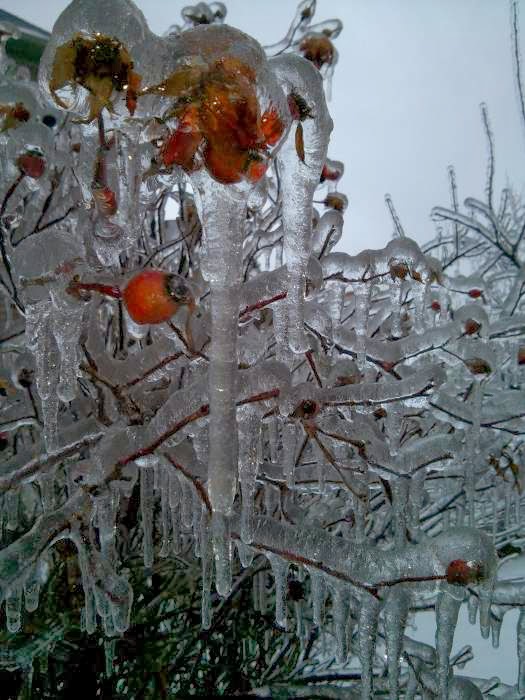
The ice storm started Saturday evening and continued all night into Sunday morning. We lost power early Saturday evening. In the morning, when we went over to my parents, I took some pictures. It did look beautiful and surreal, but it was also deadly.


It looked like the scene from a post-apocalyptic movie. Trees and branches were broken and lying around, and cars were abandoned on the roads, completely encased in ice.


It was easy to tell which houses had power (and thus, heat); they were the ones without a thick coat of ice on the windows.


It took us over forty five minutes to dig out my sister's car, which was left on the driveway and had a layer of ice on top about half an inch thick.


After about half an hour's of scraping and warming up the car, we managed to open a door and roll down the window. The ice remained outside.
 
 
It reminded me of a Tom and Jerry cartoon when the temperature had suddenly plummeted, and everything froze in an instant. Kind of like some scenes out of Day After Tomorrow.


As I write this, I know that it may take time (up to 72 hours!) but insha Allah, my life WILL return to normal once power is restored. However, there are some in the world who are not so fortunate. Only 15% of the people in Gaza have power or water at any one time, and refugees in Syria are dying in the cold due to lack of shelter and food.

We in the First World are truly blessed, and we should do something for others less fortunate, and always give thanks to Allah for our blessings.

Thursday, December 12, 2013

Conversations at a Bong Wedding

I attended a lot of weddings this summer. Bengali weddings in Canada are the best. We have Bengali people, Indian food, Pakistani dresses, Caucasian waiters and Arab imams, all under one roof. You can take a ginger ale and pose as if you are drinking Champagne for your Instagram. And our weddings aren't usually segregated, so it's fun, with music and masti and all.

Then there's these conversations:
Heavily made up aunty: Hey beta, how are you! I saw you when you were yeh high! How much have your grown! Do you remember me?

Me: Of course auntie! How can I forget you?

Later (to mom): Who was THAT?

---
Friend 1: Are they calling out dinner by table numbers?

Friend 2: Who cares? How will people in the line know we are not Table 37 and not 11?

Friend 1: Um, we are not white. That's the table that always gets called first at a brown wedding!

---
Twenty year old son: Dad, We can't sit here. This table's reserved!

Dad: Reserved sheserved! Dhut! That doesn't mean anything!

*turns the reserved tag upside down so no one can read it*
As I said, Bengali weddings are fun.

MCs, can you please, please, PLEASE, please not use this line:

"For Those ladies that are wondering... yes I am single."

Now that's just corny.

Friday, December 06, 2013

Sexism on Display

So today, the whole world watched as FIFA made the group draws for the 2014 World Cup in Brazil. It was a glitzy affair, but one thing struck me. Have a look.


Why is the woman barely dressed and the man fully dressed?
Why is the woman a blonde representing a country where white blondes are a minority (Brazil)?
Why is the woman asking the dumb questions and the rich older man explaining? Whoever thought this was a good idea?


The countries that often try to stake a higher moral position on women's issues and feminism are often the most promoting of objectifying women's bodies.

11 Questions Bangladeshis Are Sick of Hearing

So I was reading an article on questions that Indians are sick of hearing, and I thought what are the questions that we Bangladeshis get asked all the time that royally piss us off. So, without too much thinking, here's my list.

1. Tomar bari koi?

Literally translated as "where's your house" but what it really means is which part of Bangladesh are you from. Because, God forbid we are one of the smallest nations on earth, but the north of Bangladesh can't get along with the south of Bangladesh which doesn't jive with the east of Bangladesh. Somehow, my opinion of you will be based on where you are from, even if you have never lived or been there ever.

2. Bangladesh? Where's that?

This is for the geographically challenged non-Bangladeshi folks (also known as Americans). Seriously, get a world map.

3. Oh yeah, I saw the news. Too bad about the garment workers. Hope your family is OK.

Because, you know, the whole 144 million of us work in garments. And you only hear of us when there's a flood or a building collapse. But, nice of you to be sympathetic anyways. Right before you rush off and buy the sweater on sale at Walmart.

4. So, do you like fish?

*sigh*

Yes. And roshogolla.

5. I love people from India.

I am sure they are very nice people. They did help us out during our independence war. And they always manage to conveniently lose to us in cricket matches recently. But why are you telling me this?

6. I knew this Bangladeshi guy once. His name was Akram. Or was it Aslam? Do you know him?

Sure. We shared a rickshaw together from Dhaka to Toronto.

7. Why are you not married? Or why are you not having kids yet?

Yes, uncle. I am sure if I am not married, I am going to discuss the pros and cons of the situation with you. And I am married, I am going to discuss the minute details of our family planning with you.

8. Beta, news ta lagao to dekhi. Bangladesh-e ajke ki holo.

"Boy, can you put on the news. I want to see what happened today in Bangladesh."

Why?

First of all, does ATN Bangla do anything other than show off the latest music video of the channel owner's wife, or news every hour?

And second, it's the same news every day! You could watch a news from last year or yesterday and it would be the same.

Today, in a hartal, the police did a lathi charge. Three men were killed, and twenty has been admitted to Dhaka PG Hospital. Four cars and three buses were set on fire. The Opposition has lambasted the government for heavy handed tactics. The government maintained the Opposition has engaged in looting and arson and their protest was illegal.

On to sports ...

I think I speak for everyone in Bangladesh when our politicians take those expensive foreign trips, "Can you please STAY there? Don't come back, ever!"

And the uncles always discuss politics (as if they are going to bring about some change). If you had to summarize that discussion, it would be:

Haseena = Indiar chamcha
Khaleda = kichu parena

9. I don't know why you guys separated from us Pakistanis. We are the same people. You are just like us.
 
Too bad Bhutto and Yahya Khan didn't think so.

10. You guys love books. I heard Bengalis love books. And rice. Right?

So? What's wrong with that? Also, see #4. What Bengalis think today, and all that.

11. You are Muslim? Oh, I LOVE shawarma.

Allah sent down the Prophet Muhammad, peace be upon him, so mankind could be guided. That's my belief. Notice the absence of any culinary product on that statement.
 

Thursday, November 28, 2013

Is The Great American Experiment Over?

Today, as Americans celebrate Thanksgiving, and Canada gives thanks that we are our own country (with better healthcare, low crime, and no guns), it is appropriate to ask if the great American empire is in decline.

Great empires fall in many ways. Some fall over night, much to the surprise of everyone. A good example of the former would the USSR, which crumbled almost overnight in 1989 - 1990 with the fall of the Berlin Wall and the end of the Soviet war in Afghanistan. No one could believe the USSR would collapse so thoroughly, and it did. An ancient example of this would be the Sassanid Empire, which at one point was poised to gobble up the Romans, controlling Damascus, Jerusalem and parts of Egypt. Yet, almost overnight (in historical terms), in merely a decade or two, it collapsed so thoroughly and was taken over by the Rashidun Caliphate.

Other great empires take their time to decline. The decay and stagnancy is known to all for sometime, yet the empire still continues to be a force to reckon with. Until, at a critical moment in history, it simply ceases to be a power. Two great examples of this would be the Roman Byzantium empire and the Ottoman empire. The Romans would gain and lose territories in wars for over a thousand years, before slowly continuing to wield less and less power, until the Ottomans ended their misery. The Ottomans in turn were at their peak under Suleiman the Magnificent, after which the rot set in and they were referred to as the "Sick Old Man of Europe".

Others may appear dead, yet rise like a phoenix from the ashes. A good example of the later would the Russian Federation, the successor state of the USSR. No one could predict Russia would once again be a strong force in 2013, and it is.

The question is, which scenario fits the United States of America?

The signs of stagnation have been there for some time. America's political system is broken. The parties hate each other and block each others' legislations on the slightest pretext. Lobbying, which is another form of legalized bribes, is paramount - money talks. China has overtaken the US in terms of academic papers published. Manufacturing has mostly gone over seas. The gap between the haves and the have-nots is huge (the so called 1% 99% divide). For the first time in generations, the incoming generation is going to earn less, carry more debt and have less benefits than the previous generation. The population is growing older. America's foreign influence and power is on the wane, as new, young nations start to throw their weight around. They have a leader who seems to have embraced this new status quo as inevitable.

And, yet, it's not all gloom and doom for an American.

First, the United States of America has an enviable and unsurpassed military strength. Their armed forces are stronger than the next few nations combined, and have a huge technological lead over their rivals. I was recently in San Diego, and had the occasion to visit a naval aircraft carrier. The power and might of this ship, now decommissioned but used as late as the war on Iraq, demonstrates the capability of the US to strike anywhere in the globe in a manner unprecedented in history. And this is just their federal forces. Their National Guard and the reserves alone could defeat the armies of many other nations. Combined.

Second, while the strength of the Chinese (current) or the Soviets (former) comes from a projected show of force, from the dictatorial leadership at the very top, America's power comes from values. Every American believes in freedom and everything that entails, and it's their shared values system and self belief that has driven this nation forward. For a Chinese, their government is the power. For Americans, the government derives its power from the people. That is a powerful weapon to have.

America has seen dark times before. Vietnam nearly turned the country into a recluse. The second Iraq war and the needless in fighting between the right and left drove them to near bankruptcy. Yet, they have always managed to turn around quickly, and sharply. There's no reason to believe that behavior is going to stop. Yes, there are now more upstart nations such as India and China on the horizon, but they still have a long way to go.

As long as every American believes the union is still worth fighting for, as long as every state believes it's better to be in the union rather than try to wing it alone as a state, as long as they have their military might without getting sucked into a deadly, vicious, bloody war, there is no reason to believe America is even close to beginning their decline. I don't see them falling any time soon.


Wednesday, November 27, 2013

When Searching For Right Becomes Wrong

I recently published a post over at Love Inshallah entitled "How I Met My Son's Mother" (the title was a play on my favourite sitcom How I Met Your Mother) which outlined my thoughts on the whole arranged marriage process, as well as some provocative conclusions I had of the whole situation. Of course this has resulted in some ladies getting mighty upset. There has been posts and counter posts against my original post, the editors thought it wise to add a disclaimer, and even altmuslimah got into the act. The kicker was the paragraph on the altmuslimah article that actually seemed to say being involved in relationships prior to marriage is a good thing.

The whole hullaballoo reminded me of one wise saying that I feel is a guiding principle of my life.

"Right is right, no matter how few follow it, wrong is wrong no matter how many acclaim it."

Having said all that, let me distill it all down to five main points which even those that had a go at me will have a hard time disproving. I don't mind criticism, and I ignore insults (both Prophet Musa and Muhammad, peace be upon them, far better men than lil 'ol me, faced insults and harassments over far more complex issues).

1. It is good to get married early. It is the Islamic thing to do.

Can any one really deny that Islam encourages us to get married early? The Prophet Muhammad (peace be upon him) got married early (25 years of age), most of the Sahabah got married in their late teens or early twenties, and it was the practice of the Muslims to get married as soon as they were able to and were of age. And we are talking about guys here. Girls used to get married as early as 13 or 14.

Times and societies differ, but I think in today's day and age, a man should start looking for a wife sometime after finishing his university undergraduate degree (say around the age 24), while a woman should start looking sometime before (perhaps at the age of 21).

2. It is easier for a younger woman to get married as opposed to an older woman. Men generally prefer a wife younger than them.

Of course, whenever you say this, someone will then bring up the example of the Prophet (peace be upon him)'s marriage.

Muhammad (pubh) married Khadija who was 40 and he was 25, and she was much older than him and married 2 times prior to marrying the prophet, and had several children previously ...

While quoting this famous example of Khadijah, many people conveniently forget three main parts of her story.
  • To be academic, Khadijah was only 28 years old when she married the Prophet Muhammad (peace be upon him), not 40. This is the most authentic opinion. She was thus only 3 years older than her husband, who was 25 [Source, go to 21:30].
  • Khadijah herself married at a very early age (her first marriage).
  • Muhammad (peace be upon him) married Aisha, Hafsa, Zainab etc. all of whom were much younger than him (and who had all, with the exception of Aisha, been married before, and at an early age). In fact, Aisha was also very young, having just stepped into puberty.
  • He encouraged young, single men to marry young, single women.
It is common sense that a woman is much more desirable as a marriage partner when she is 21 as opposed to when she is 31. And of course, no one decides to get married and poof! the next day they have found someone. It takes about 1-2 years of searching before you find someone. Starting at an age of 21 means a woman will generally get married when she is 23 or 24. If you start at 25, it's much harder.

Most guys who are in the arranged marriage process will be of the age 24-29. When you factor in that the average age difference between the husband and the wife in an arranged marriage is about 2-4 years, then you know why, as soon as a woman crosses the age of 25, she finds the pool of available men diminishing, and it gets harder and harder to find a suitable match.

A small disclaimer. I am not criticizing girls or guys who started looking but didn't meet someone. They are not single by choice. No, I am criticizing those who delay marriage for career, for education, for "I want to relax and have a good time".

3. Be chaste. You should avoid relationships before marriage and be professional in dealing with the opposite gender.

Surah Qasas verses 23-28 is a great anecdote of how Musa (peace be upon him) met his first wife. Men and women can and will interact, and this interaction should be professional, to the point and exactly what is necessary. A woman, if she likes a man, can initiate the proposal and Musa, as a young man, deals with the marriage proposal with the girl's father in a proper and honourable manner. There is no flirting, no "going out", no improper behavior at all. In fact, Allah praises his wife as "being shy".

Lo and behold.

I don’t appreciate the idea of if someone has been in a relationship then she’s automatically off the list

We’ve both had relationships before we met each other, and they made us more complete and interesting individuals, with a better idea of what we want and don’t want in life and in a partner

And of course, the altmuslimah paragraph (kind of strange for an article on a site with 'muslim' in its name to promote this sort of activity).

I’m tired of the attitude that women should be blamed for the relationships they’ve been in, and I’m frustrated that dating implies sex in the minds of so many Muslims. Spending some time with members of both sexes can be done in a halal way, can lead to a successful marriage in the best case, and (if nothing else) is a healthy way of developing comfort and a mature attitude towards relationships – a time investment that pays off when you get married ...

If you are "dating", you are going out with some member of the opposite gender just to have a good time, and you are then in a relationship (emotional, physical, doesn't matter) with someone ("he's my boyfriend"), then you are doing something that is not sanctioned by Islam. Can anyone really argue that? If you love someone, get married to that someone.

Some disclaimer, I don't think a broken engagement, or time spent with someone in 'getting to know them' (for a short while, for the purpose of marriage), or a divorce counts as a bad thing. Engagements break, you spend time getting to know someone honourably to find out that it won't work, and marriages fail - these things happen. No, what I absolutely cannot recommend is getting into an emotional (and perhaps physical) relationship with someone where all of society knows you as a couple and yet you are not married for years - why?

This applies both to guys and girls. I don't like the double standard that sometimes gives men a free pass for their behavior (boys will be boys) but holds girls to strict standards. A chaste, Muslim woman who has kept herself in check should have the full right to say no to a prospective suitor that has 'played around'.

4. Don't follow those who are not into arranged marriage.

It has to be said, if you are going to go the arranged marriage route, than don't follow as an example those who are NOT going to go through this route. Let me give an example.

There are many people who will have found their special someone through dating, or perhaps they met in the university and kept in touch, and then later started to "go out" with this person on dates and so on. These people are not the 'arranged marriage' type. They are in a long term relation with their special someone, and after some suitable time, they will get married. If the relation breaks, then they will find someone else to date, and marry.

These Muslims, while still being officially "single", are in a relationship. They live alone, work after graduation, further their careers while being in a relationship. However, they are not married, and will probably get married after a long courtship, perhaps at the age of 28 or 29.

If a Muslim man, or worse yet, a woman, looks to these people as examples, and thinks, "Wow, I too get remain single until I am 26 or 27, and then get married" they are in for a delusion. The two processes to marriage are completely different.

5. When it comes to children, women make the greater sacrifice, and Islam encourages having children.

A righteous son can act as sadqah jariah, and a daughter can be the key to paradise.

There is a reason why the mother has a very high status in Islam. In modern times, it's not sexism, or the glass ceiling, or the 'old boys club' that is the primary reason men rise higher in the corporate ladder than women. It's motherhood.

At some point, a couple will face the decision to start a family. And this will put the woman's career in jeopardy, even with great maternity benefits and laws. While she's at home, male colleagues will get that promotion, gather that extra experience and take that training. This is a sacrifice.

Moreover, most fathers will say they would prefer their wives to take care of their kids at home if money wasn't an issue.

This is another reason a woman should marry early. Then she has enough time to focus on her career or fulfill her dreams of higher education, whatever it may be, and still leave enough time for children.


These were my main points from my Love Inshallah article. As I expected, many feminists attacked me at once for my "privileged views" (whatever that may be). However, the truth has to be said. If people ignored their own opinions and their own "feelings" and dedicated more time to loving, understanding and following the sunnah, the Marriage Crisis that we in the Western Muslim community are facing (largely as a result of our own actions) will be no more.

Thursday, November 21, 2013

On Wearing a Chain

As a young kid in the Middle East, one of my "phases" included wearing a metallic chain around my neck and a steel bracelet on my wrist. It was 'cool' and everybody at school was doing so (remember, this was the 80s). On the other hand, I was still brought up with good values and was quite religious. So this one time, I went to visit this city (Abu Dhabi - the now famous, bigger brother of Dubai) with a couple of friends and it was time for afternoon prayers. We entered a mosque.

After we were done with the congregational prayers we saw the imam making his way towards us. As soon as he was upon us he started to gesture wildly and say something. Whey I say "say something" I really mean "shout". And in Arabic.

A peculiar feature of the UAE is that many of the people who live there, even for decades, do not speak Arabic. Us included. So while the imam ranted and frothed at the mouth, we could only look on helplessly. Some Pakistani labourer then took the trouble to translate to us.

"He doesn't like that." He pointed to the chain and the bracelet. "It's very un-Islamic. Please don't wear that to the mosque."

Silly me, I didn't know that bad 80s grunge look existed in 6th century Arabia to be banned by the Prophet (along with, say, soccer). I remember being shocked at the imam's behaviour (we were only 10 or 12 at that time!) and thinking, "I am never coming to this mosque again!"

I remembered this incident, years later, this summer.

It was a nice summer's day in Toronto and I went biking with a neighbor. We cycled through routes and hills and were riding home when it was time for Maghreb. As luck would have it, we were riding past the biggest mosque in the city.

"Let's go in," Was my decision but I was a bit apprehensive in what I was wearing. A white t-shirt with the Toronto skyline picture on it, and the long shorts. The shorts reached past my knee, which was good (and made it halal), but still left a LOT of the ankle exposed, which is probably not people normally wear to the mosque.

I went in, expecting another frothing imam.

I was pleasantly surprised. No one paid any attention to me.

I went in, enjoying the refreshing blessing of God that is Air Conditioning, did my ablutions, did the congregational prayers, and then even said salaam to the imam (just to tempt fate) and then left. While leaving, I saw plenty of people dressed like me.

They seemed happy to be there. And I wondered, how many attendees does a frothing imam lose?

Friday, November 15, 2013

A Cruise to The Thousand Islands

A baby will not change our travelling habits, my wife and I had decided, when we found out we were having our first born. We will still travel the world like when we were first married.

Yeah, about that. That boast went the same way as "I will not resort to using television to get my kid to eat" and "my kid will not throw a temper tantrum".

So this summer, while deciding on a place to visit near home and with not much preparations, we decided to take the Thousand Islands Cruise near Kingston, Ontario. Now, Kingston is a great Canadian city not too far from Toronto (about 2 and half hours of driving), but the better Thousand Island cruises depart from Gananoque, which is about another half an hours driving. So, three hours, not too bad, we thought.

Cue a huge traffic accident (a truck rollover) that blocked traffic all across the province, and we arrived five hours after schedule to catch the 3 pm cruise.


The cruise ships were huge, and since this was the middle of the week (did I mention I was on vacation), we had the whole ship mostly to ourselves. Which was good for the toddler so he could walk run about, and bad for us as I wanted to just curl up and sleep, not chase after a baby. But then we imprisoned strapped him safely him in his stroller as he went to sleep, and we could enjoy the beautiful scenario that is The Thousand Islands.


The islands (there's actually more than a thousand, believe it or not!) were mostly privately owned, and we saw the houses (and resorts) of the rich and famous as we cruised by. Oh, to have an island of your own! The famous Kirrin Island of the Famous Five fame (Enid Blyton fans will get this) came to mind.

The cruise ship stopped at the Boldt Castle. Since the Castle is on an American island (the islands are between US and Canada), only those allowed to enter USA could visit it. Which included any Canadians on the boat, but you had to have your passport). We had chosen not to do the castle, as it wasn't very stroller friendly, so we just admired the view from the outside. To think, at one time, this was the property of just one man!


Of course, we were not the only ones enjoying the water on a lovely summer day.


The next morning we spent a bit of time visiting some of Kingston's other tourist attractions. These included Bellevue House, the residence of Canada's first Prime Minister, Sir John A Macdonald. it was interesting to see how simply he lived, for a man of his importance.


 Of course no visit to Kingston would be complete without trying Chef Rahim's biryani. Halal food was pricier in Kingston as compared to Toronto, but it rounded off what was an excellent weekend visit.


Amongst other attractions that we didn't visit as I had been there previously is Queen's University. If you are in Toronto and looking for an interesting day trip or a weekend trip, Kingston is highly recommended. 

Monday, October 28, 2013

4 Reasons Why I Do Not Give A Discount (Or Give My Book Away for Free)

It is now well known amongst my friends that I have published a book. Most of them are genuinely happy for me, and many have purchased a copy (or several!) of the book from me at full price. I am also happy to say the book is now available via Eastern Toybox for those in Canada.

To all those who supported my effort and purchased my book, I would like to say a sincere thank you from the bottom of my heart.

However, sometimes I occasionally get the "Hey, do your friends get a discount" or "can I get your book for free" question. Most of the time it's in jest and I laugh off the good natured ribbing. Sometimes though, it's a passive aggressive statement with multiple shades of intent. The book sells for $US 24.99 on Createspace, for $US 24.99 on Amazon USA (they sometimes apply a discount on their own initiative), and $CAD 26 at Eastern Toybox. I made a resolve early on that I will not be discounting the book at all when I sell them personally to friends or relatives, and NEVER give anyone a free copy. These are the four reasons why:

  1. It seems that "Business is business" and "separating business from pleasure" is an Islamic thing. The Companions of the Prophet Muhammad (peace be upon him) did not give the Prophet a discount, so why should I give anyone a discount? In the famous hadith of Jabir ibn Abdullah, this young man bargained over the price of his camel that he was selling to the Prophet, until he got a price that he felt comfortable with. Of course little did he know that the Prophet Muhammad (peace be upon him) was merely looking for an excuse to help Jabir financially without hurting his dignity!

    To reiterate, in Islam, when you conduct a business transaction, it is perfectly allowed to charge a price for your product that you think it's worth, and it's up to the other person to purchase from you, or not, regardless of the relation between the two of you.
  2. The book is a quality product that I have made and it took a lot of time, effort and money. When you ask me to give you the book for free, you are saying that essentially, my time and effort have no value.

    I have not forced anyone to buy my book. I have not even sent an email out to my friends asking them to purchase it. The ONLY email that I have sent out to all of my friends is ONCE, at the beginning, when I merely informed them about the book getting published, and my asking price for it. I also told everyone that should they wish, they can place an order through me, and if not, can they kindly forward the information of the book to anyone they think would find it useful. That was it.

    So if I am not putting a gun to anyone's head obligating them to buy my book, or treating them any differently if they didn't, then I certainly don't feel I have to discount my book for anyone.

    My book is a product in the marketplace. If there is a demand for it, if people value it, then God Willing it will sell. If someone does not feel it's appropriate to pay $25 for it, that's their decision and I can respect that. But when someone wants the book, but is not prepared to pay for it, that says more about them than the product.
  3. Muslims have to be prepared to pay out of their pocketbook if they want quality products.

    For example, we want our Imams to be "cool", to be an expert of not only the Quran and Islamic theology, but to have knowledge of the sciences, to be experienced with the modern world, to know about the culture of the land, to "identify with the youth", to be an excellent orator, to be good at interfaith work, etc. etc. The list goes on. Yet, when it's time to pay the imam, the masjid boards dither and do not want to pay him an appropriate salary that will enable the imam to enjoy a high quality of life. Caliph Abu Bakr, the first Caliph of Islam, was not prepared to give up his business and attend to the duties of the Caliphate full time until he was given an appropriate wage - which he later claimed was insufficient and demanded a raise.

    Today, we want high quality educational Islamic books for our kids. We want proper Islamic stories depicted on the silver screen and television using high quality production techniques (the Omar series being a prime example). We lament the lack of proper Islamic education for our kids, or the inadequacy of good Islamic Sunday school speakers. We want gyms in our mosques, not to mention daycare facilities and equal women's places. Yet, when it comes time to donate or contribute financially for all of these, we balk. We do not support the local mosques. We are hardly involved in their planning board. We pirate lectures and movies. We do not patronize Islamic conferences and belittle their efforts. And when someone publishes a book or makes a movie that, in their opinion, raises the bar, they are shunned for not giving their friends discounts or "free" tickets.
  4. I plan to use most of the proceeds of sales for future dawaah work. Other books are in the planning pipeline, with a book on Surah Qasas scheduled for release in April 2014. I also need to purchase some photography equipment for images of even higher quality than the first one. These all take resources, and I have shunned from asking anyone for donations for free. My plan is to produce a product and make it self sustaining as far as possible.
As it is often said, most of the time you get what you pay for. And this is why I refuse to discount my book for anyone.

Friday, October 11, 2013

Surah Kahf Illustrated Quran Book Now for Sale

Alhamdulillah.

I wanted to personally give you all the good news that the illustrated book on Surah Kahf (with 146 pages containing over 220 images, built using Lego bricks and other toys, with the full exegesis (tafseer) of the Surah Kahf) is now out for sale.  It’s available primarily on Amazon.com (US, Canada and Asia), just in time for Eid. Here are the links to order the book:

Amazon (for readers in USA, Canada, Asia, Africa)
http://www.amazon.com/Teaching-Kids-Holy-Quran-Meaning/dp/1492331023/ref=sr_1_1?s=books&ie=UTF8&qid=1381082251&sr=1-1
Amazon (for UK customers)
http://www.amazon.co.uk/Teaching-Kids-The-Holy-Quran/dp/1492331023/ref=sr_1_1?ie=UTF8&qid=1381082843&sr=8-1&keywords=mezbauddin+mahtab

Amazon (for readers in France)
http://www.amazon.fr/s/ref=nb_sb_noss/275-2910051-4791220?__mk_fr_FR=ÅMÅŽÕÑ&url=search-alias%3Daps&field-keywords=mezbauddin+mahtab

Amazon (for customers in Germany)
http://www.amazon.de/Teaching-Kids-The-Holy-Quran/dp/1492331023/ref=sr_1_1?ie=UTF8&qid=1381082795&sr=8-1&keywords=mezbauddin+mahtab

Currently there is a sale on the book (regular price US$24.99, but discounted on Amazon.com) available for early orders. I have ordered previously on Amazon.com, and have been a highly satisfied customer with their prompt shipping and customer service, and can thoroughly recommend them.


Just a bit of note about the price – it’s expensive to print a book of images (as opposed to text), so I have priced it almost at cost. Any proceeds from the book is going towards purchasing a new camera macro lens and light box (for better pictures in the future) and more dawaah work with the next Quran book (on Juz 30), insha Allah, amongst other things.

For those who live in the Greater Toronto Area, I have another offer on the book. They can place their order through me and it will cost them only $25 (no taxes, no shipping). To do that, please email me with your contact info so I can get in touch with you. I will be placing my bulk order for all GTA customers on Oct 13, 2013, insha Allah.

Here are some images from the book:


Wednesday, August 07, 2013

A Declaration

Morning. The Hilal Committee of Greater Toronto Association, the Crescent Committee and the Saudi Salafi organization have agreed that tomorrow, the 8th of August, 2013, is ..
.
.
.
.
.
a Thursday. It's a great joyous occasion when all Muslims of the Ummah will observe Thursday together on the same day (except those pesky fitna-loving Polynesians). Sheikh Al Bouty was involved in the marathon negotiations that brought all the leaders of the community together. The Salafs initially wanted to wait till Friday, considered holy by the Wahhabi Islam (and other sects), to celebrate Thursday, but came around when informed that to get to Friday they would have to observe Thursday first.

In other news ISNA has declared by virtue of calculations that Thursday is not theoretically possible this week, and declared tomorrow to be Friday.

Thursday, May 02, 2013

What I Told Aldo

I now know NOT to give out my email to store cashiers when they ask for it.

Friday, April 12, 2013

Canadian Spring


Made this meme quickly today. This April has been a mixed bag so far. We had temperatures into the teens (celcius) and yesterday and today we had snow and hail.

The Bangladesh Crisis Explored

Bangladesh is right now in the middle of a political crisis that threatens the very well being of the country and her people. I wrote an article for MuslimMatters exploring the origins and status of the present situation. You can head over there to read the article, which has been very well received by the readers.

The Bangladesh Crisis Explored


A Country in Crisis

“Are there any Hindu temples in the country that has not been burnt yet?”

A survivor wailed her lament to the news cameras. The channel was covering the latest atrocity in Bangladesh, when miscreants torched a small temple and desecrated the idols.

Bangladesh is in the middle of a political and communal crisis. Long been spared the curse of communal violence (Bangladesh did not see the heavy Hindu-Muslim rioting of the 1947 partition, as well as serious clashes when neighboring India was plunged into chaos in 1996, 2001 and 2006), the country's 9.2% Hindi minority are now the target of outright violent hostility. Today, Amnesty International released a statement deploring the wave of violent attacks against the Hindu minority ...

More here on MuslimMatters: The Bangladesh Crisis Explored
 

Thursday, March 14, 2013

An Ideal Mosque - Part I - The Praying Area

Lately there has been a spike of interest in mosques and attendance by Muslims of religious services. WoodTurtle has a series on Unmosqued, which is also the title of a documentary/movie. Here in Toronto, we are blessed with a huge number of mosques that vary widely in the prayer space and range of services provided. I am personally blessed to live near the Islamic Foundation of Toronto (IFT) and the Islamic Institute of Toronto (IIT), both of which are sterling examples of great Western mosques.

Recently, few close friends of mine who live way north in Brampton have started an movement to establish a mosque in their area, called BARIC. Since these are friends I have known from my Middle East days, and I was talking recently with the general secretary on the role of women in a mosque, their activity has led me to start thinking of what an Ideal Mosque should look like. This post is an attempt to crystallize those views. I will start with the praying area.

An Ideal Mosque of course existed during the time of the Prophet Muhammad (peace be upon him) and from all reports, this is a rough sketch of the praying area of the Masjid-e-Nabawi. Please note that this is simplified; there were many doors leading into the mosque courtyard from nearby houses, there was an area reserved for the Ahl-Suffa (men who lived at the mosque because they were poor or chose to be, and whose primary job was to learn the new religion and its tenets, teach new converts and who lived off the generousity of the larger Muslim community).

Note that there was no barrier between the men, children and women. It was simply a large space in which the front rows were taken by men, the middle by children followed by women, with a row gap in between. Everyone could see the imam and hear him directly. This was my original opinion of what an ideal praying space in an ideal mosque should be like. This is how the praying space at IIT is.

Recently, after having been blessed with a child, I noticed that I was no longer as enamoured with these type of mosques as I was with mosques that had separate enclosed ladies' sections - as that meant my wife could nurse our son in privacy and change him if needed. We have all seen these type of mosques.

Notice the smaller section for women and the use of close circuit television and screens (which were definitely NOT there during the Prophet (peace be upon him)'s times). Moreover, which the enclosed space was great if you had a baby, this could be a service provided by the mosque (have a separate room for nursing or changing babies). Why intrude into the praying space? Moreover, the din of children crying and/or running around in a small(er) praying space doesn't make it very attractive to women worshippers, as is the fact that you have to have a working television cable system to just follow the imam.

However, some women just like the idea of a separate women's space so they can pray in privacy and in solitude. The problem is that for younger women, used to being treated as equals everywhere else, this apartheid type barrier seems regressive. Moreover, the women's space is now fixed in size, and is often much, much smaller than the men's. So, what can be done?

Now I see more and more what a visionary Zarqa Nawaz was with the episode called "The Barrier" - the second episode of the series "Little Mosque on the Prairie". While the episode had some glaring faults, her solution to the barrier question seems to satisfy everyone (or no one).

Leave half the space covered by a barrier, but leave the other half open for women who like to pray behind the imam. Does that sound fair?

What is the praying arrangement at your mosque? Is it ideal? What are your views of an Ideal Mosque? You can get in touch by leaving a comment here, or by emailing me, or getting touch via Twitter (a_bong).

Thursday, October 25, 2012

Er ... Maalish

"Hey, this water from the shower is hot!"

"Um ... try turning the tap the other way, maybe that's the cold water."

"Well, this says this is cold water. It's marked blue as well."

"Why don't you try it?"

"OK ... um .... the water is just getting hotter and hotter."

"Er ... maalish!"

Welcome to the Middle East, where the shower has two settings, hot and hotter, and maalish is a word used to smooth over everything when you can't do anything.

"This car is actually driving on the shoulder of Dubai - Abu Dhabi highway!"

"Maalish!"

"The government first declared Eid on Saturday and now is saying it's on Friday! How can you just play around with the Islamic calendar?"

"Maalish!"

"I ordered 7 bananas, you only delivered 6!"

"Sorry, sir ... Maalish?"

(As an aside, you can actually get your groceries delivered to your house, for free. I am still trying to get my head around that one.)

Can this actually work in a Western context?

"Hey! You were supposed to have sent me this report three days ago!"

"Maalish!"

"You want to go for holidays for how many weeks?!"

"Maalish!"

"This blog post has absolutely no point!"

"Maalish!"

Sunday, October 21, 2012

A Blessing in Disguise

I am currently in Dubai for a much needed vacation.

Overheard the following conversation between two at Fajr prayer at a local mosque:

Voice 1: Oh, I love coming to the mosque. Look, there's some blessing inside here, inside this community. The prayer is over, but no one wants to leave. Can you feel the rahmat, the barkat, the blessing?

Voice 2: It's just air conditioning. You know it's as hot as a furnace outside, that's why you don't want to leave ...