Showing posts with label calgary. Show all posts

Monday, January 09, 2017

Western Canada Diaries - The Complete List

Update: For 2019 links, scroll to the bottom.

2016:

Overview
Here's a total complete list of all my posts regarding my great Western Canada road trip of 2016. If you are thinking of visiting the Rockies, or travelling to BC, you may find these links useful. 

This was a rough map of our travels.


Calgary
- General Introduction
- Olympic Plaza
- Nose Hill Park, Chestermere and Peace Bridge

Banff & Jasper
- General Planning for Banff & Jasper
- Banff Gondola (Sulphur Mountain)
- Lake Minnewanka Cruise
- Bow Falls & Vermilion Lakes
- Lake Louise & Moraine Lake
- Icefields Parkway
- Lake Peyto and Bow Summit Lookout
- The Crossing Resort
- Columbia Icefield Glacier Adventure and Skywalk

Edmonton
A visit to the capital of Alberta, and the West Edmonton Mall (once the largest mall in the world) and City Hall.

Drumheller
Around an hour and half drive north east of Calgary lies the town of Drumheller, also known as the Dinosaur Capital of the World, or Dinosaur Valley.

Whistler
Recalling our journey through Canada's deadliest highway, Route 99's Duffey Lake Road, and a pit stop at Whistler.

Vancouver
- The Capilano Suspension Bridge
- Stanley Park
- Other highlights of Vancouver

Victoria
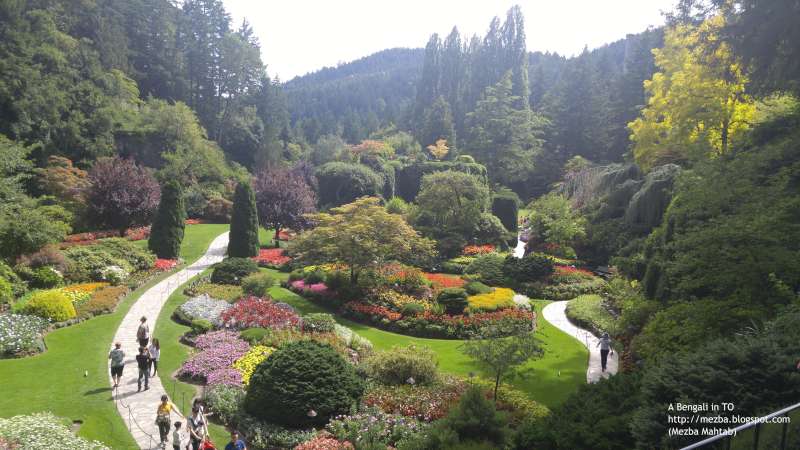
A trip to this beautiful, historical city on Vancouver Island, and nearby attractions such as the Butchart Gardens.

2019:


Tuesday, December 13, 2016

Western Canada Diaries - 20. Victoria

[ Continued from Part 19 - Vancouver's Highlights  ]

This post will be the last in the Western Canada series, as Victoria was the last city we visited before heading back to Calgary, and then flying home to Toronto.

To drive from Vancouver to Victoria, you have to take the ferry. That means driving from Vancouver down to Tsawwassen, which is where the ferry terminal is.


The cost is both based on the type of vehicle, as well as the number of people on board the vehicle (hint: it's not cheap!). If you are lucky when you arrive, you can board the next ferry if there's room, otherwise you will have to park your car in a queue, shut it off and spend some time in the ferry terminal. We were lucky on the way to Victoria, but on the way back we had to wait an hour.


There's hundreds of cars inside the huge behemoth ferry, and once inside you get set for a roughly 90 minute ride.


The ferries are really huge, multi storied, and have excellent washrooms, restaurants, and seating arrangements on board. If the weather permits, you can even go outside and take in the lovely scenery as the ferry traverses past numerous islands.


Some of the richest people in the country own homes in these islands. The weather is moderately warm throughout the air, and most of these parts may not even get snow in the winter. It's really a different type of Canada.


A gong and an announcement lets you know when you should be returning to your car, since once the ferry docks, every one has to exit in queue, and you don't want to be holding everyone up!


We had started out quite early, so by noon, we had crossed the strait and the ferry had now docked at Swartz Bay. Our next destination was Victoria, but on the way we would visit the world famous Butchart Gardens.


The Butchart Gardens is actually a group of several floral display gardens. It's located in Brentwood Bay, which is a short drive north from Victoria.


The gardens receive close to a million visitors each year. They have been designated a National Historic Site of Canada. We met people who told us they visit the gardens every year - as there is always something new.


In 1964, the ever-changing Ross Fountain was installed in the lower reservoir to celebrate the 60th anniversary of the gardens.


The whole place was huge, and had numerous ponds and reflecting pools to relax and take a break.


It was a hot sunny day, but the garden provided respite from the heat. We were also quite unprepared for exactly how big the whole area was!


The layout was easy and straightforward, and wherever there were stairs, there was also an alternate accessible route, which was great for those with strollers, like us.


They even had a children's carousal (which surprisingly is the only carousal on Vancouver Island).


Even though tickets were slightly on the expensive side (something $30 odd), it's well worth it.


By the time we had finished sightseeing the Butchart Gardens, it was late afternoon (5 pm) and we hadn't eaten lunch yet. So we drove to our hotel in Victoria, had some lunch and rest, and then ventured out in the evening for the inner harbour.


Victoria is the capital of the province of British Columbia. It's also, as we soon realized, one of the most picturesque and British of Canadian cities. Named after Queen Victoria of the United Kingdom, Victoria is one of the oldest cities in the Pacific Northwest, with British settlement beginning in 1843.


Lots of people were out, taking in the glorious sunset and admiring the buildings lit up in bright colours.


The famous Empress hotel (which is where the royals usually stay) is a good place to go for British High Tea if you are inclined. The cost is about $60 per person.


The city has retained a large number of its historic buildings, in particular its two most famous landmarks, the Legislative buildings (finished in 1897) and the Empress hotel (opened in 1908). The city's Chinatown is the second oldest in North America after San Francisco's.


This reminded me of Kolkata's Victoria Memorial.


The Royal British Columbia museum is nearby, and is something many tourists visit when they are in Victoria.


It wasn't chilly at all. Slightly breezy, given that we were in the harbour, but fantastic weather overall.


Victoria is very popular with boaters with its beautiful and rugged shorelines and beaches. Victoria is also popular with retirees, who come to enjoy the temperate and usually snow-free climate of the area as well as the usually relaxed pace of the city.

The next day we visited Mile 0 in Beacon Hill Park.


Beacon Hill Park is also famous for its statue of Terry Fox. It's a myth that this is where he started running from (due to Mile 0, which is actually for the Trans-Canada highway).

Then it was time to head back to Calgary. This time we would choose a SANE route (unlike the crazy highway 99), and return to Calgary via Kelowna.

It was actually a long first day. We drove from Victoria to Swartz Bay, took the ferry to Tsawwassen, and then drove by Vancouver all the way to Kelowna, where we stayed for the night.


The next day we drove from Kelowna to Calgary. We started from Kelowna in the morning, drove to Revelstoke, where we rejoined the Trans-Canada Highway 1. Then it was simply going back the way we had come. Around two hours away from Calgary, we crossed the border from British Columbia back into Alberta.


We made a quick stop at Lake Louise (after all, how could we not) and then in Banff, before heading back, late at night, into Calgary. The only thing open that late was a halal pizza store, which was fine by us!


And that was the end of our great Western Canada road trip. We would fly back in two days to Toronto.

Over all, we spent slightly over three weeks, had lots of fun and adventures, and made highly cherished memories. I fell in love with the great Canadian Rockies. I would gladly redo this journey again.


Wednesday, October 26, 2016

Western Canada Diaries - 15. The Dinosaurs of Drumheller

[ Continued from Part 14 - Calgary (Again)  ]

Around an hour and half drive north east of Calgary lies the town of Drumheller. The drive to Drumheller is a different drive compared to the Calgary - Banff drives. The road passes through completely flat terrains and farm lands, and almost no mountains.

As you get closer to Drumheller, the topography suddenly changes to badlands and dry lands. This is Drumheller, also known as the Dinosaur Capital of the World, or Dinosaur Valley.


Why dinosaurs? In 1930s, Drumheller was just a little town (having started life as a railway station) of coal miners. In 1955, however, the Dinosaur Provincial Park was established. Covering 80 square kilometres, including 27 kms along the Red Deer River (and Drumheller), the Dinosaur Provincial Park is recognized as the richest dinosaur fossil site in the world.

 
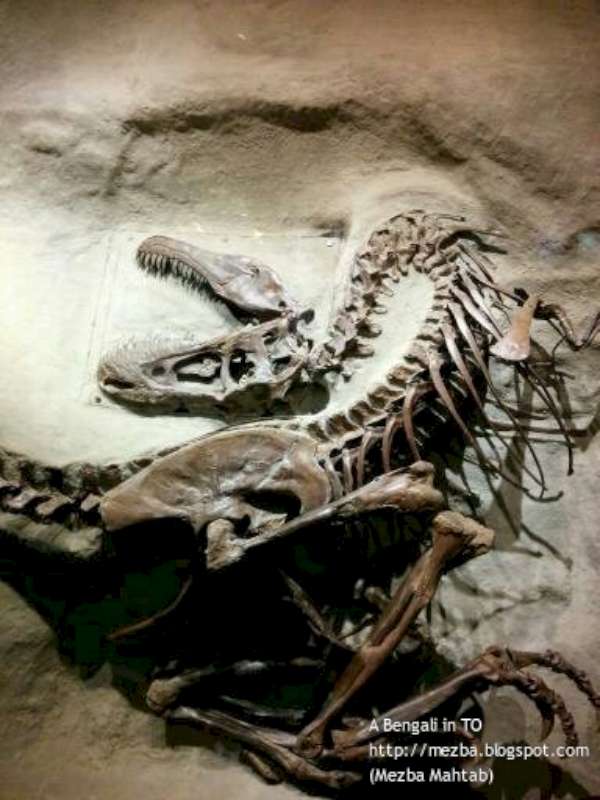
An exhibit at the Royal Tyrell Museum

Ever since 1889, when the first fossil of an  Albertosaurus, a smaller cousin of the famous T-Rex, was discovered, more than 400 dinosaur skeletons have been found here, representing over 55 individual species. No other area of comparable size anywhere has yielded such a large number and diversity of dinosaur fossils.

And of course, when you have such a rich diversity of dinosaur fossils, there has to be a museum.


The Royal Tyrell Museum is a huge tourist draw (and the main draw of Drumheller). There's over 130,000 fossils here, and the museum is huge.


More than 4,400 square metres (47,000 sq ft) of the museum's 11,200 square metres (121,000 sq ft) is dedicated to exhibits.


There's even perfectly preserved specimens of dinosaur eggs! The theme of the museum is a series of chronological galleries celebrating the 3.9-billion-year-history of life on Earth.


One of the most popular is "Dinosaur Hall", with over 40 mounted dinosaur skeletons, including specimens of the famous Tyrannosaurus Rex and Triceratops.


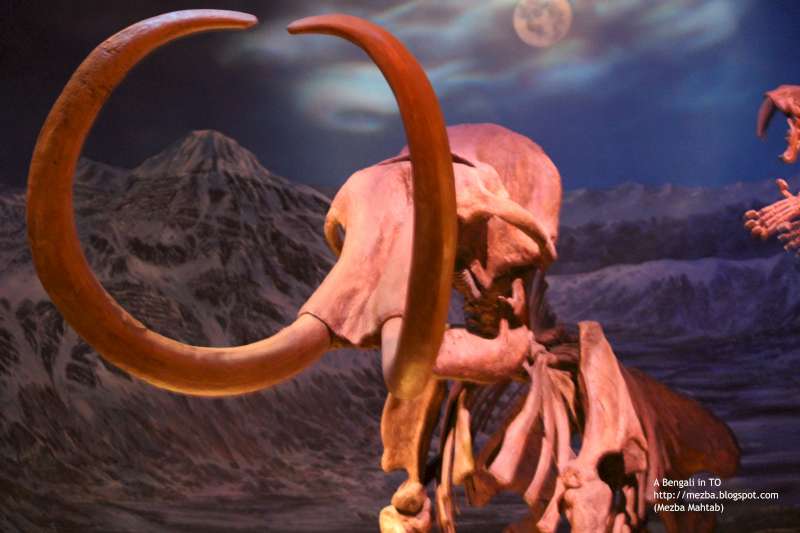
Of course the museum has an eye on modern mass entertainment, and you get to see the stars of the Ice Age movie series (well, their fossils).

 
Manny?


Why are there so many fossils? We took a guided tour, and our guide told us that the true draw of Dinosaur Provincial Park, however, was in the dirt. 

Dinosaurs walked the Alberta Badlands during the Late Cretaceous Period (around 75 million years ago,) when the sub-tropical climate (in Canada!) nourished lush forests and great rivers that flowed east toward a warm inland sea.

 
"Tropical weather? In Canada? You don't say!"

The environment provided homes for a variety of creatures big and small, including sharks, turtles and crocodiles. Reptiles with wingspans wider than a small plane soared across the skies.


Those great rivers left behind the sand and mud deposits where dinosaur bones were quickly buried and then fossilized, and now form the hills and hoodoos of the Badlands.

 
When the last ice age ended 13,000 years ago, water from melting ice carved the valley where the Red Deer River flows, helping to create perfect conditions for fossil preservation.


You can easily spend 4-5 hours here. There's all types of exhibits, even about Jurassic era plants and microbes. They have activities for kids (and families) to go fossil hunting in the nearby badlands. Kids loved the dinosaurs (in fact my four year old knew most of them, because of Harry And His Bucket Full of Dinosaurs). Who said TV wasn't educational?

You will see dinosaurs (well, models of them) all over Drumheller.


The other big attraction (and I mean big) of Drumheller is the World's Largest Dinosaur.


This is a giant model of a Tyrannosaurus Rex (even larger than the known sizes of an actual T-Rex, approximately 4.5 times larger). The height is 26.3m, and you can climb the 106 stairs (for a fee).


It's situated in a park (with water fountains and splash pads) with free parking nearby. By the way, having a giant model of something in the middle of a small Canadian town is an unusual but common Canadian tradition.

Drumheller is a day trip from Calgary. You start in the morning, explore the Royal Tyrell Museum, go to the World's Largest Dinosaur site (most people don't go up, usually), and if you have time go to the Atlas Coal Mine, and then head back to Calgary. When making an itinerary, Drumheller's a must on the trip.

Tuesday, October 25, 2016

Western Canada Diaries - 14. Calgary (Again)

[ Continued from Part 13 - Edmonton  ]

Returning to Calgary from Edmonton, we had a few days before leaving for Vancouver and Victoria. And you do need a few days to unwind from a Banff / Jasper trip. For one, there's so many pictures to sort and upload!

I had already covered Calgary's Olympic Plaza and a brief introduction to the city, so in this post I want to just talk about a few of the other places in and around Calgary that you can visit. I will also cover Drumheller in the next post.

Nose Hill Park is a huge park atop a hill in north west Calgary. It's a gigantic city park (almost 11 square kilometres) but the main attraction is that you can see all of downtown Calgary from one spot in the park. It's a nice viewpoint and we did explore a few of the trails, but mostly we came to take a picture of Calgary from here.


If you want a family shot with Calgary in the background, this is the place to come.


Chestermere is a small city by Chestermere Lake. The nice thing to do in Chestermere is just sit by the lake and enjoy the beautiful serene scene.


It's not the great glacier lakes of the parks, but it's only a fifteen minute drive from where we were staying.


The lake is also used in the summer for waterskiing, wakeboarding, fishing and other sports. It's a nice spot for a picnic (there are benches) or simply being lazy.


There's also a playground nearby, and a place with a lot of benches that you can lounge in and soak up the sun (if you are so inclined, we desis tend to run away from the sun).


Peace Bridge is a bridge over Bow River in Calgary. Yes, the same Bow River that begins in the Rocky Mountains and is part of the Bow Falls and the Bow Valley.


The bridge features the red and white colours, as red and white is present in both the Flag of Canada and the Flag of Calgary.


It's a pedestrian bridge but also has separate bike lanes. It's designed to be barrier free for those users who have challenges with mobility. The bridge opened to the public in 2012.


The red and white patterns make for interesting pictures and I had to wait a little bit to get a shot with no one in the frame. The things our families have to tolerate when they have a photo hobbyist amongst them!


The people of Calgary are an outdoorsy type when the weather allows them, and we saw quite a lot of boats and rafts on the Bow River as we were exploring the bridge. This trend would be doubled when we were visiting Vancouver. As a general trend, Western Canadians seem more sporty and outdoorsy than Ontarians. Maybe it has something to do with their beautiful landscape.


Calgary has some other attractions such as the Calgary Zoo, but as I said I wanted to explore sights that were unique to the city. You visit one zoo, you have visited them all, mostly. Calgary is also, as I said, quite huge and it takes a long time to drive from one part of the city to another.

Coming up next: Drumheller.