Thursday, April 23, 2020

How Taiwan Conquered the Coronavirus with Common Sense

This is Ms. Tsai Ing-Wen. She is the first female President of Taiwan. She also leads the country with the best response to COVID-19.


Let's look at some of her stats and then her steps.
Stats:
  • Taiwan is geographically right next to China, and had daily flights to Wuhan, the epicentre of the virus.
  • When the epidemic began, John Hopkins university predicted Taiwan would be the second hardest hit country.
  • Right now, they have a population of 23 million, out of which only 427 are affected, and 6 deaths. For comparison, Canada has 37 million people, more than 40,000 cases and over 2000 dead. Not to mention, Taiwan's 23 million live in an area smaller than Nova Scotia.
Now let's see how they handled their epidemic.
Short summary: Masks, hand wash, travel ban, aggressive tracking and quarantine. Also, ignore the WHO.
Result: Everything is open, economy hasn't crashed, curve is basically flat.
Details:
  • early action (from January 1, 2020). Starts to board flights from China and check passengers for symptoms.
  • Travel ban from ALL flights from Wuhan, and then China, shortly after.
  • Put a triage centre in airport to identify possible cases
  • Strict quarantine: you get paid for staying in quarantine, get food delivered to your house, get your symptoms checked thrice a day. Break quarantine and you are fined several month's salary. They would do this for all POSSIBLE cases, not just positive cases.
  • Aggressive hand washing - every public building had sanitizing stations, and you get your temperature checked before you enter. You are not allowed to enter a building if you show symptoms.
  • Masks - Everyone MUST wear masks when out. Taiwan saw they have 40 million masks in their stockpile, so they cranked up production to 10 million masks PER DAY and put a price limit on the masks to prevent price gouging.
  • They integrated travel, immigration, customs and health care databases and included cellphone tracking to identify possible cases and improve contact tracing.
  • QUARANTINE the sick, not the healthy - was their motto.

Today, Taiwan is a classic example of using common sense and the old age methods with new technology to control an epidemic. They went hard, they went aggressive - AND THEY WENT EARLY. Today their parks, restaurants, schools, offices, public services are all open, and yet their numbers are low.


Compare this to Canada where we had no travel restrictions, no forced home quarantine, no database integration, no masks (STILL NO INSTRUCTION ON MASKS), no aggressive stockpiling of PPEs, no protection from PRICE GOUGING or PANIC BUYING, no hand washing in public buildings, NO AIRPORT measures ... the list goes on.

Sources:

Tuesday, April 21, 2020

A Tale of 3 Women: Jacinda Ardern, Dr. Henry and Dr. Tam

Let's talk about three women.

Two of them are smart. The third one - Let's say I am not a fan.

1. Jacinda Ardern


They say a leader is tested in a crisis, and how you deal with it makes or breaks you. By that definition, Ms. Ardern should be the leader of the world. Her first crisis was last year during the horrific mosque shooting in Christchurch. The whole world saw how she dealt with the fall out, with empathy, determination, unity and determination. Now let's see how she dealt with the corona virus:

  • COVID-19 testing is widespread
  • Out of 5 million, only 12 people died
  • Banned travellers from China in early February, before a single case in NZ
  • Banned foreigners from NZ in mid-March, with only a handful of cases
  • National lockdown from early March, much earlier then other Western nations
  • Unveiled a four level alert system
  • With a degree in communications, kept her citizens abreast of events, and used empathy in her Facebook live sessions
  • Inspired a collective effort from all NZ, public health departments and hospitals.

Though it's early to say, by all counts, her efforts seem to be working.

2. Dr. Bonnie Henry 


She is the Provincial Health Officer for British Columbia, and the first province to see a spike in the number of growths of COVID-19 positive cases. Yet, as of now, whether you go by confirmed cases or hospitalizations, by raw numbers or a per capita comparison, the virus has steadily grown in Ontario and Quebec, but flattened in BC. Why? It is her leadership, as well as luck and timing.

  • She looked at the data from Quebec's March break and correctly deduced it's mostly community transmission from USA. This was at a time when Dr. Theresa Tam was saying the "risk is low".
  • She immediately asked BC citizens to STOP ALL TRAVEL outside of Canada. This was on March 11, the same day Doug Ford of Ontario was telling people to travel on March break and "have a good time".
  • She immediately put a halt to health workers working in more than one place. This immediately broke the back of community transmission. As a comparison, Ontario did this only last week (4 weeks later).
  • Improved testing per capital (Ontario is still behind its goals), reserve stock piling of PPE and focus on social distancing.
  • Unified messaging and response to the public, and a better health care system than other provinces.
  • She saw the data and introduced corrective BOLD measures in BC much before the rest of Canada caught on.
  • Dr. Henry's direct experience in overseeing Toronto's SARS and Canada's H1N1 outbreaks is the type of background that's impossible to quantify in a situation like this.

3. Dr. Theresa Tam


Now let us quantify the "contributions" of Canada's top doctor.

  • On Dec 31, 2019, Taiwan warned WHO about the virus spreading from human to human. WHO rejected the idea. Guess who sits on the oversight committee of WHO? That's right, Dr. Tam. This is the committee that is there to make sure WHO does the right thing, and NOT bow to pressure from China. 
  • On Jan 14, 2020, WHO tweeted the virus was NOT transmitting from human to human. This, despite doctors treating patients in China getting sick. Dr. Tam did not stop them, but actually repeated that rubbish, despite warnings from Taiwan and Singapore.
  • Jan 20, China finally admitted the virus was transmitting from human to human. Dr Tam insisted there was no risk to Canadians. Flights continued from China.
  • Jan 25, first Canadian case, a man who returned from Wuhan.
  • Jan 26, second Canadian case, that man's wife. Dr. Tam insisted risk is "low".
  • Jan 27. Dr Tam chastised those worrying about the virus as "racism".
  • Jan 31, Trump acted on his "China ban". Meanwhile Dr Tam continued to insist there is no risk, and travellers continued to come here from China. Canada's numbers showed a steady rise.
  • Feb 19 to March 4 - As Iran became the new hotspot, Dr. Tam continued to resist calls for travel bans. By this time, Singapore, New Zealand, Vietnam, Taiwan, USA, Italy had all acted on travel restrictions, but not her. Canada's numbers now began to rise sharply as returnees from Iran began to show signs of infection. 
  • By March 4, returnees from USA were showing signs of infection. One of them rode the TTC and Go before testing positive. Dr. Tam insisted the "risk is low". She also said travel bans were of no use. She also said don't wear masks.
  • March 12 - Mrs. Trudeau tested positive, and all hell broke loose.
  • March 30, the CDC says you should wear masks. Dr. Tam still denies it's of any use.
This is why Dr. Theresa Tam needs to be fired.

Monday, March 30, 2020

Why Dr Theresa Tam, Chief Public Health Officer of Canada, Needs to be Fired

Recently there was an article on how Canada's COVID-19 response is led mostly by women. A lot was made of the fact that Canada's Chief Medical Officer, the Deputy PM, and the top doctors for several provinces and cities (Toronto/Vancouver) are all women. Now to me, I was never a big fan of Trudeau's gender balanced cabinet. Personally, it doesn't matter for a job whether you are a man or a woman. What matters is how good you are at the job. And I am not that impressed with this group.

Going by our numbers and our state of the nation right now, most of these women (sorry, most of these employees) have been HORRIBLE at their job. And at the top of the pack, led by Chief Public Health Officer of Canada and head of the Public Health Agency of Canada, Dr Theresa Tam.

As far as I am concerned, when all this is over, she needs to be FIRED. 

The only reasons she shouldn't be fired right now is that we are in the middle of a crisis.  At the minimum, there should be a public inquiry on how badly she has mismanaged this crisis and how these so-called "experts" have failed Canada every step of this crisis.

Let's take a look at some facts.


  1. As early as Dec 1, 2019, Taiwan told WHO that the virus causing COVID-19 was a case of human-to-human transmission. WHO chose to believe China, which defiantly lied and said it was NOT a case of human-to-human transmission. Canada (and Theresa Tam) chose to believe WHO.

    You can say it was the fault of WHO, which was trying to appease China, but why did Dr. Tam not take the cautious and conservative approach of preparing, just in case ? You are there to prepare for the worst, but hope for the best.
  2. As things deteriorated in China, Dr. Tam continued to emphasize that the risk to Canadians was "low". It wasn't until January 15, 2020 that Canada activated its Emergency Operations Centre. Yet flights from China continued to come to Canada daily. Plane loads of people, whether they were affected with COVID-19 or not, continued to flood into Canada.

    US President Donald Trump banned anyone from China coming to USA (with certain exceptions) on January 31. Meanwhile Dr. Tam continued to toe the general line that "travel restrictions does not work". Canada did not ban foreigners from coming to Canada until mid-March, when it practically had no choice.
  3. Iran reported the first case of COVID-19 on Feb 19. One of the first cases in New Zealand came from a family who had recently traveled to the Islamic Republic. At least three of the first 12 cases in Canada came via Iran, as did all 33 initial cases in Iraq. In the United States, the first confirmed COVID-19 case in New York City was a health-care worker who had returned from Iran, and Los Angeles also identified a coronavirus patient from Iran who passed through LAX.

    Yet Canada continued to allow passengers from Iran to disembark in Canada. Flight after flight came in, and plane loads of people disembarked. One of the infected travellers even rode the TTC and Go on March 4, 2020. This was when community transmission probably started in earnest. And yet, Dr. Tam continued to insist the risk to Canadians was "low".
  4. On Thursday morning, March 12, 2020, Ontario premier Doug Ford told the people who were planning to travel for March break to go ahead "and enjoy themselves". This, despite the fact that USA (the most likely destination for many) had become a hotbed of COVID-19. Remarkably, even on March 12, Dr. Tam had no dire warnings for Canada, even as the situation worsened. By this time, Europe (especially Italy) was the new epicentre of the disease. Still planeloads of passengers continued to come from Italy into Canada with no screenings at the airports and no restrictions. Where was Dr. Tam? She was sleeping on the job, it seems. Risk to Canadians - "low".

    Just wash your hands.
  5. Suddenly, late Thursday night, March 12, 2020, Sophie GrĂ©goire Trudeau, the wife of Canada's Prime Minister Justin Trudeau, came down with flu like symptoms after travelling from UK. She was tested for COVID-19, and the result came back positive.

    All hell suddenly broke loose.
It wouldn't be unfair to state the Canada woke up after Mrs. Trudeau tested positive. Suddenly we stopped going to work. Suddenly schools were closed - initially for two weeks, and then indefinitely. The situation was no longer "risk is low". The situation was suddenly "stay home". Businesses were immediately shut down if they were considered non essential. 

The number of cases jumped, and continues to go up daily. The healthcare workers are suddenly complaining of a shortage of masks, gloves and other PPE.  There is now a Global News article on how we have to choose who gets to live in Canada due to a shortage of ventilators. The news is grim and this week is critical.

So the question remains - why is Canada now REACTING to the crisis, rather than being PROACTIVE? It remains Dr. Tam's responsibility to make sure we were not just prepared for this crisis, but on top of it, without it ruining our economy. 

So how did we go from "risk is low" to the "situation is grim" in the blink of an eye?

There was never a perfect solution to this. What we could hope for was to delay the onset of the crisis as long as possible and limit its effect once it was here. 
  • When China became the ground zero for the crisis, we should have immediately banned all travellers and flights from China. In fact, Air Canada suspended its operations in China long before any government directive.
  • When Iran became the epicentre, we should have barred any traveller who had been to Iran in the last 14 days from entering Canada, whether they were showing symptoms or not.
  • When the disease moved to Italy, we immediately should have suspended all travel from Europe. 
  • In all these cases, surprisingly US President Donald Trump took these decisions. But even he was late, and his details diluting the intent of the action. But at least HE TOOK the action. Canada, based on Dr. Tam's advise, never did. 
  • If you argue that this would mean denying Canadians entry to Canada, it would only be temporary. Just like we did for Canadians stuck in Wuhan, there could be separate flights to bring Canadians home (just like now).
  • When you bring these Canadians home, they should have been quarantined in a place away from the community (just like those from Wuhan were held at CFB Trenton for 14 days). Then you would not have had the community transmission which is how it is spreading now.
  • When reports emerged of Seattle being the hotbed of USA cases, we should have immediately closed the border to US citizens except essential travel. Instead, we were told "the risk is low" and we continued.
  • When the first infected traveller rode the TTC, that should have been it for start of social distancing and other measures. Yet we were told the "risk is low" and we continued.
  • Until Mrs. Trudeau got the virus.

There are things that we can be doing RIGHT NOW to abate the disease. Yet, we are not.


  • Get local factories to make test kits and ventilators. If we need them, we have them. If we don't, we can export them to the States.
  • Why are we not ramping up immediately to produce more PPE? Where is the plan for that?
  • How long are we planning to stay in shut down mode? Where is a plan to return to normal? How are you going to sanitize public transit?
  • Today there was a speech by the PM and for the first time we are hearing that masks are a good thing. Yet for so long we were told "don't wear masks".
  • What is up with the supply chain? When can we expect Lysol wipes?
  • What are you doing to keep control and track of inbound travellers to avoid another spread?


So, Dr. Theresa Tam, what did you actually do with all that expertise? And why should you not be fired for gross negligence? 

Thursday, October 10, 2019

Is this world a simulation?


As a believing and practicing Muslim who also loves science fiction, I find the recent musings of some key figures (such as Elon Musk and Neil deGrasse Tyson) that "this world is a simulation" very fascinating. These quasi-philosophers (and I like to play one on the internet) say that we are all avatars, or characters, in some big simulation and nothing is "real".

We know from our religion that our souls (programs?) are created separate from our bodies (avatars) that exist only in this world. We know that the sun and the moon are precisely programmed (Quran, 55:5). In this world, everything we do is recorded by the angels in a scroll (our activity log).

We know that God created the universe in 6 days. In Islam, we have long accepted that these "days" are not like our 24 hour days, unlike Christianity. And part of the reason is that we know this universe took millions of years to take shape. And God says His day is not like our days. But consider that on His day 1 He ran Day1.exe. On His day 2, He ran day2.exe. I am just speaking in terms a computer layman can understand, but you get the point. The time inside a simulation does not mean the same time outside the simulation. We know this from our own simulations, such as SimCity or The Sims. And you don't even need time dilation to explain this.

Since Allah is the creator of everything (39:62, 13:16 etc), He is also the Creator of Time and Space.. He is not bound by constraints of Time and Space. That exists for us inside our reality (our simulation?).

Just to throw a spanner in the works: If it were proven that we live in a simulation, that would prove a creator, but not a perfect creator. Since our Creator is perfect, one would expect that the simulation would be perfect. If a simulation is only detected by its flaws, we would probably never know.

Then, Allah says in the Quran: "And what is the life of this world except the enjoyment of delusion." (Quran, 3:185).

The final answer: We probably wouldn't know. And after death (game over), we probably wouldn't care, except our final score!

Tuesday, September 17, 2019

East Coast: Peggy's Cove (Day 9)

Continued from Day 8 ...


Peggy's Cove is an iconic East Coast destination. And to think - we nearly skipped it!

If I had to do the trip completely my way, I would have put a whole day here. Simply because I would love to photograph this famous lighthouse in the morning at sunrise, then in the middle of the day when it's busy, and then again at sunset with the famous golden sky behind it, and then at night when the lighthouse actually lights up.

As it was, we only spent a couple of hours there, enough to explore the site and take lots of pictures. I don't have a lot to share here as most of the pictures have people in them, and it's the same lighthouse but at different angles, but still I will try to recount the journey.

Clearly lighthouses are Nova Scotia's most
popular souvenir as well

Nova Scotia is home to over 160 historic lighthouses, some of them world famous (such as Peggy's Cove). Peggy's Point Lighthouse is one of Nova Scotia’s most well-known lighthouses and may be the most photographed in Canada. It was built in 1915.

Cheticamp is still on the Cabot Trail, so when we left the morning after our Cabot Trail trip, we still continued on the trail for some time.


There were still some nice coastal vistas to occasionally stop the car and take in the scenery. We were enroute to Halifax, which was some 4 hours away, and Peggy's Cove was another 45 minutes further from Halifax.


The East Coast is the true definition of a Road Trip. It's not just the destination, but the journey. There were so many things to see on the way. Just little road side stops. Small attractions. Memories. You really have to take your time and explore this part of Canada. Soon though, we left the coast and started to move inwards into the province of Nova Scotia. Interestingly, nowhere in Nova Scotia is more than 67 km (42 mi) from the ocean.

Nova Scotia, another interesting point of note, is the second most densely populated province in Canada (first being PEI). It is also the second smallest of Canada's ten provinces (again, PEI is the smallest).


Almost five hours after leaving Cheticamp, we entered the Peggy's Cove area. We passed a small memorial on the way to the lighthouse. This memorial is dedicated to the victims of Swissair 111. This memorial is about 1 km from the lighthouse.


To be honest, our initial itinerary had us travel back to Fredericton from Cheticamp, and then onwards and back towards Toronto. Suddenly we discovered we had one extra day, and Halifax wasn't too far of a drive from Cheticamp, hence we made the decision to visit Halifax. And of course, if you visit Halifax, you HAVE to go to Peggy's Cove. And boy we were glad we did!


How can you not visit Peggy's Cove! Every east coast trip from anyone I know includes a picture by this iconic Canadian lighthouse. This lighthouse, by the way, is an active lighthouse, unlike some of the other ones we saw on the trip - which were once active but now are only tourist attractions. This lighthouse is operated by the Canadian Coast Guard.


The area surrounding the lighthouse is also pretty in its own right. It was typical Atlantic Canada. Small, rustic, pristine, clean, natural, beautiful, picturesque and simple.


This cove was the scene of a youth novel by Bryan Doyle called You Can Pick Me up at Peggy's Cove (1976), which was made into a film directed by Don McBrearty and into a video released by Beacon Films, Inc., in 1982.


Peggy’s Cove is famed for its picturesque and typically East-Coast profile, with houses perched along a narrow inlet and on wave-washed boulders facing the Atlantic. Although this unique environment has been designated a preservation area, it is still an active fishing community.


The lighthouse was built around 1914 and stands almost 15 metres (49 ft) high.


The village of Peggy's Cove is likely named after Saint Margaret's Bay (Peggy being the nickname for Margaret). Another popular legend claims that the name came from the sole survivor of a shipwreck at Halibut Rock near the cove. Some claim she was a little girl too young to remember her name and the family who adopted her called her Peggy.


If you are there for an extended period of time, you can spend the day watching the waves and exploring around the rocks. There are many signs reminding visitors to exercise caution at all times, as the ocean water around Peggy’s cove is dangerous. Rogue waves (unpredictable, rough waves) commonly splash up over the rocks, even on calm, sunny days. We saw many during our time there.


Today, Peggy's Cove is a major tourist attraction, although its inhabitants still fish for lobster, and the community maintains a rustic undeveloped appearance. The regional municipality and the provincial government have strict land-use regulations in the vicinity of Peggy's Cove, with most property development being prohibited. Similarly there are restrictions on who can live in the community to prevent inflation of property values for year-round residents.


Once you are done visiting the lighthouse, you can take a stroll in the nearby village and surrounding area. There's lots of artists there, and many have shops nearby. The area around the Swissair memorial is also excellent for capturing pictures of the Milky Way on a clear, moonless night. Be cautious driving though, as the road is not illuminated at night.

It was with a bit of sadness that we bid adieu to Peggy's Cove as we headed back to Halifax. We knew this was our last stop on the East Coast trip, after which it was going to be a couple of days of driving back home. One last glance back at the historic lighthouse, and we were on our way.


Thursday, September 12, 2019

East Coast: The Cabot Trail (Day 8)

Continued from Day 7 ...

The Cabot Trail is one of the world's most famous drives. Every travel list in North America has the Cabot Trail as one of its must drive highways.

Rising from the sea and clinging to mountains, the 298-kilometer-long Cabot Trail is a winding mix of roadway, paths, stairs, and stunning beauty that takes you from unreal ocean vistas to quaint fishing villages.


Since the Cabot Trail is a circular trail, every one debates whether to go around the Cabot Trail clockwise or anti-clockwise. We decided to do it anti-clockwise, starting from Baddeck, so this meant we were on the outside lane with the water. I would recommend the anti-clockwise route, as this means you can immediately stop on the side if you see something interesting, and the elevation keeps going higher and higher as you drive.

As a sidenote: fill up on the gas before you head out.

It was a cloudy start to the day. It had been raining in Baddeck the night before, and the forecast called for more rain. We were hoping the forecast was wrong, and thankfully, soon it brightened up.

 A small inlet of water, beautifully reflecting the sky,
somewhere just north of Baddeck


I had assumed this would be a challenging drive - somewhat like Highway 99 from Whistler to Vancouver. On the contrary, it was pleasurable drive. There were some ascents and descents, but nothing crazy.


The first stop was the Wreck Cove General Store. Now why did we stop here? Simply because almost every guide book and Tripadvisor post said to stop here. I wouldn't say there was anything much. Their lobster sandwiches are apparently "world famous" (you beginning to see a theme here?) but at $16 wasn't worth it.


You also get curious souveniers such as this. Now I am hoping this is really chocolate. I don't know though. In any case, we were soon out from the store after getting some magnets and what have you. And once again, it was starting to be a clear sky (even though it was slightly overcast) and bright sun breaking out from the clouds.


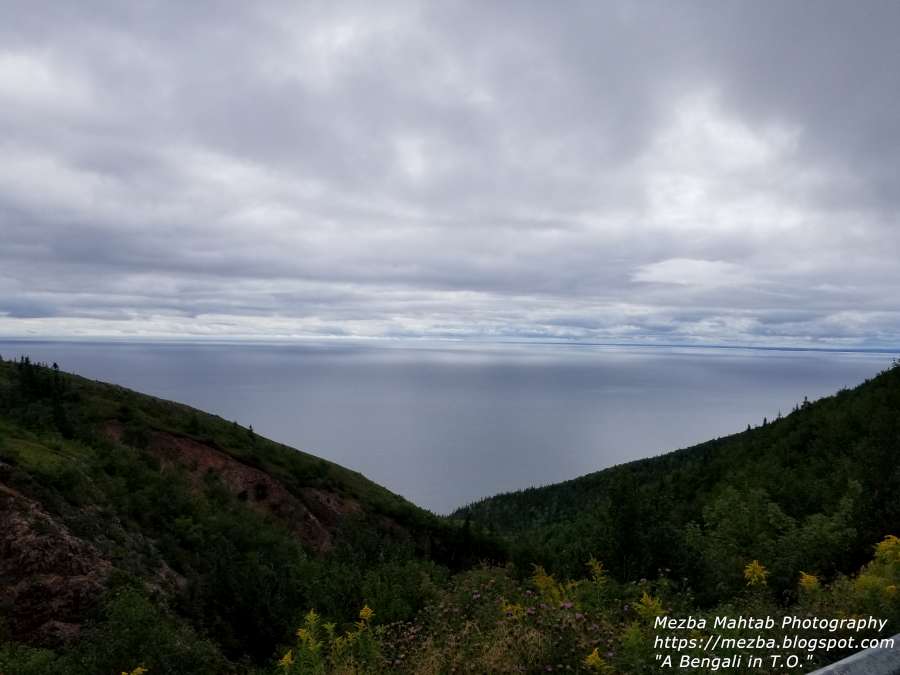
Soon we stopped at a spot that I can probably describe as an inverse Lake Louise. It was really beautiful - the mountains, the grass, the trees and then the wide expanse of the ocean. Just like anything natural - photos (particularly phone photos) do not do it justice.


Phone pictures seem to flatten out the colours, but in reality it was vibrant and the contrast was vivid. No wonder lots of cars just pulled over to take pictures!


As we started out again, it was surprising that without much elevation change being apparent, suddenly we were back at ground level with the water. I really don't know how the mapping of the road was; but sometimes we were quite high up and sometimes we were quite low on the ground.


We stopped again some time before Ingonish Beach. I don't know what the name of this Cove was, but it was not hard to imagine that at times of yore, this would have been the perfect place for smugglers to bring their wares onto shore, where known people would be waiting, perhaps in the middle of the night with lamps, to ship those goods into Canada.


It was now bright and sunny - no sign of those clouds or rain. And soon we entered Cape Breton Highlands National Park. This park occupies a huge terrain north of the island, and the Cabot Trail touches the park in many places, and you need a park pass to drive through it.


The beautiful Ingonish beach

The ocean, the rocky beach and the 
winding road hugging the coast 
line, with breeze blowing through your 
hair as you drive into the sunset

The beautiful Cabot Trail, with the
sun now beating down quite mercilessly


Waves crashing into the rocky beach,
with no one around for miles


Lakies Head is a beautiful place to stop and soak in the scenery, just north of Ingonish on the Cabot Trail. There are plaques describing the seasonal migrations of animals into the area.


It's an easy stop along the highway with great views of the ocean and sea birds. There's some warnings about the dangers of rogue waves so just be mindful.


It was now getting to be way past noon, and thus time for lunch. And for that, we stopped at one of the restaurants that almost every guidebook and tourist post seemed to praise. The Rusty Anchor.


I don't have to describe the sea food. Fried haddock. Pan crusted cod and haddock. Mussels. Clam. Corn. More haddock. And it was all so good, and disappeared from the plate so fast also!

An interesting take on the fish burger

You can never go wrong with the
standard order of a fish and
chips - just make sure there's
no beer batter if you don't
drink alcohol


They had some interesting signage
demarcating the mens' and womens'
toilets


A great restaurant - the hype is definitely
worth it - and I highly recommend
The Rusty Anchor if you are
visiting The Cabot Trail

Views of the road and the ocean
from behind The Rusty Anchor


The ocean - so blue!

The Skyline Trail: Most people who visit the Cabot Trail also hike the famous (or shall we say "world famous") Skyline Trail.

At the end of this level trail, a dramatic headland cliff overlooks the rugged coast. You can enjoy an eagle's view of the Cabot Trail as it winds its way down the mountain and vehicles look like toys. And you can watch for whales in the Gulf of St. Lawrence from the viewing decks. Moose, bald eagles, bears and numerous boreal birds live in this habitat.


This was the start of the Skyline Trail. Now since our group included kids and seniors - we simply were not going to do the 7 km trail. It just wasn't going to happen. Instead, we did the next best thing. The lady at the Park Canada told us a secret.

The very next stop on the route AFTER the Skyline Trail was a stop that was at the end of the trail. So you essentially get the same view as if you have just hiked the trail. Minus the boardwalk, of course.

AND WHAT A VIEW!!!


And once again I have to say pictures, as usual, do not do the scene justice. You JUST cannot take proper pictures that show the beauty of such a place. We would return to this spot after checking into our hotel at Cheticamp, the small village we were staying overnight, nearly at the end of the Cabot Trail (and close to Baddeck since this was a loop).

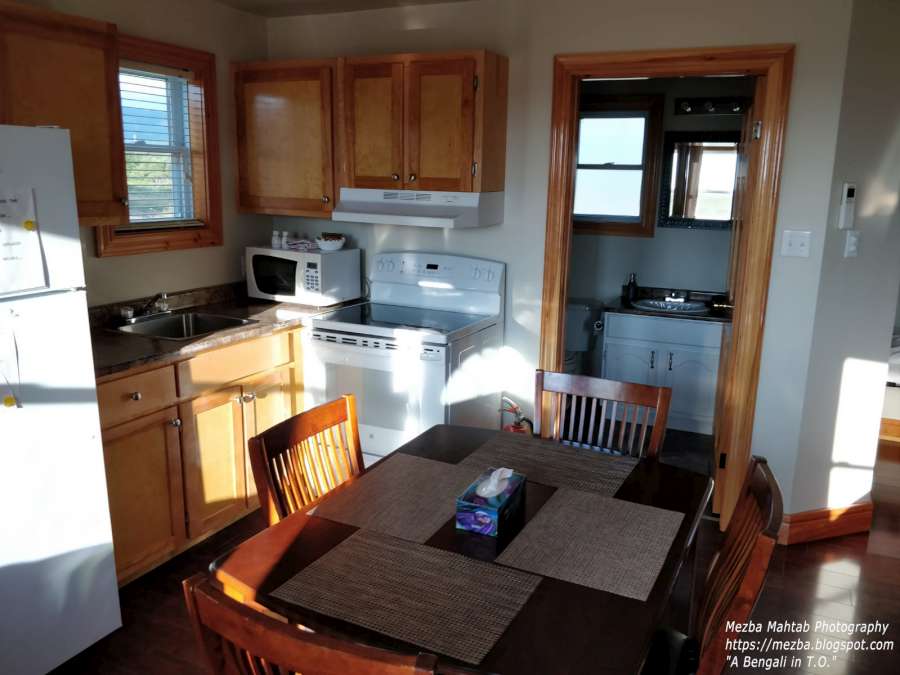
Our cottage (or chalet, as they called 
it) at Cheticamp


Cheticamp is a very small village. So small - there is one grocery superstore that closes by 5 - after which you only have a small convenient store to shop from. It's a beautiful French town though, and you can explore the fishing boats and the little houses. We decided to drive back to the trail to catch the sunset.


There's something to be said about sunset into the ocean. It is so pretty.

Dinner time - and why not pizza. Plus ... wait for it ... they have a world famous pizza store (but of course).


Overall, the Cabot Trail was one of the highlights of the trip. It was definitely worth the hype, especially the northern portions where you are so high up and you get some excellent views. You need a brilliant sunny day though - which is what we had - and not rain if you were to explore the Cabot Trail's beauty.