Showing posts with label Animals. Show all posts

Tuesday, September 08, 2020

Bird Kingdom at Niagara Falls

 If you love photography, and taking pictures of nature in particular (especially birds), you will LOVE Bird Kingdom at Niagara Falls. They usually have deals online (either group on, or through your workplace, or even on their site), so check online before visiting. Paid parking is available right under the attraction, and you need at least 2 hours (close to 2.5) for the whole attraction.


They have a small reptile section ahead of the main exhibits. Don't miss this - as some of the iguanas, lizards, and snakes are a sight to see in themselves. Just adjacent to this exhibit is where they have some talking birds.


These talking birds can be a mouthful! They rotate the birds, so you may get a different experience on each visit. The trainers are quite friendly and the birds enjoy a good rapport with the staff. They are not in cages, and fly around occasionally. 


Each of these talking birds have their own personality, and some are more talkative than others.


Usually these Amazon parrots (I am guessing their are parrots) are the loudest, and enjoy performing for the cameras. You can talk to one of the trainers and they are usually happy to put on a small "performance" for you.


For many of us from Bangladesh, it's the closest you can come to some of the exotic birds from back home, including a mynah bird, which can be thousands of dollars here in Canada. 


From this exhibit you proceed to the small birds aviary.


It's fun watching these little birds build nests, eat, fly around (inches over your head at times!) and have a ball.


The large birds aviary is next, and there are lots and lots and lots of big birds, all flying around (and some not flying), eating, relaxing, all within an arm's reach.


Some of these birds allow you to get really close.


Bird Kingdom is a (relatively) cheap fun activity for the whole family at Niagara Falls, sometimes cheaper than many of the quick garish thrills on nearby Clifton Hill. Take your camera with its telezoom lense, and have a blast!

Monday, August 05, 2019

Canadian Rockies: Jasper


If Banff National Park is the most visited national park in Canada, then Jasper National Park is the crown jewel of the Canadian Rockies. Whereas Banff is more developed, has more infrastructure for tourists and has the more popular spots, it is also the more crowded (sometimes overwhelmingly so) park. Jasper is more wild, more scenic, and is for the more adventurous.

You access Jasper from Banff through the Icefields Parkway. I have written about this highway before - it is the most scenic highway in the world. You may think this is being over hyped but it's not. It really is that pretty. You have to stop numerous times on various lookout points just to take it all in.


There's not a lot of hotels or options in the southern part of Jasper, so we stayed the night at a resort midway between Banff and Jasper.

Columbia Glacier and the Canyon Glass Floor


This is the last outing you do as part of the Ultimate Explorer. The Athabasca Glacier is at the heart of the incredible Icefields Parkway, and is one of the largest non-polar ice fields in the world. It is also the most visited glacier in North America.


Here, you’ll travel on a massive Ice Explorer to a place where you can walk on, feel and drink from the fresh waters of the glacier. These vehicles are massive - each of their tires is almost as tall as a man and is worth $5000!


The glacier waters are ice cool (of course!) and incredibly fresh. No mineral water tastes like this! You can drink it straight from the source.


Then, take a jaw-dropping walk along the glass-floored Skywalk at the cliff’s edge, a short five minutes drive away.


One big difference from my last trip to the glacier three years ago is the size of the glacier. It was noticeably smaller, and I have read that they are losing a little bit of the glacier every year. The area you could walk around was definitely smaller. Another difference, though not an important one, was the variety of food in the cafeteria. They have much better vegetarian and seafood options now! Still no halal though ...

Sunwapta Falls


You must visit this falls if you are travelling through Jasper. There are two famous falls in the park (the other being Athabasca Falls), but this was is more accessible.


It is not too far off the highway, has ample parking (it can fill up but enough people are always leaving, so there's always space) and the lookout point is quite close to the falls.


First Sighting of Wildlife: Mountain Goats

Imagine going through Jasper National Park, famous for its wildlife, and not seeing any! It was our last day in Jasper and we hadn't really seen anything of note. When suddenly my son pointed this out:


Do you see it? I wonder how he saw it. And then we saw it.


It was a whole family of mountain goats.


Jasper Skytram

This is often an overlooked attraction, but do not miss it. On a clear day you get some amazing views.


We could see the peak of Mount Robson (all the way in British Columbia). That is the highest peak in the Canadian Rockies at 3,954 metres (12,972 ft). Our guide told us such clear weather (to see Mount Robson) we were enjoying happened once every week for only two hours at the top.


The small town of Jasper (from which the park gets its name) can also be seen from the top.


Keep in mind that Jasper is more "wild". Look at the barriers. These are not the child friendly barriers that are common in Banff. A small child can easily slip through them, so be careful of where your kids are at all times.


You can even go for further hikes up the mountain. Many people do. We did part of the way.


After exploring the peak, it was time to get down and go towards Hinton, a small town just outside of Jasper to the north - our pitstop for the night. On the way there, we made a small detour to Pyramid Lake, and boy we were glad we did.

Pyramid Lake and more wildlife


The Pyramid Lake (just five minutes away from the town of Jasper) is a beautiful lake, but nothing extra ordinary about it compared to the other magnificent lakes we had seen so far. What made it special was the forest and woods around it. As we were driving back, suddenly we see this ...


It's a deer. And then we see other moose and elk nearby. And then a whole family of them decided to cross the road.


More of their cousins were dotted around the small road. We drove by very slowly.


Then we approached a heavily wooded area. It reminded me of the story of Red Riding Hood. But instead of a wolf, would we see a bear?


YES! There it was!


A bear sighting is usually the highlight of wildlife spotting in Jasper. We were very lucky indeed. The bear was merely 500m away, and happily munching on her food, while we stayed safely away and took pictures.


Overall we spent two and half days in Jasper National Park, and I wish we could have spent more. There were so many other things to do, other sights to see, other trails to hike. Canada is very lucky to include Jasper!

Wednesday, October 26, 2016

Western Canada Diaries - 15. The Dinosaurs of Drumheller

[ Continued from Part 14 - Calgary (Again)  ]

Around an hour and half drive north east of Calgary lies the town of Drumheller. The drive to Drumheller is a different drive compared to the Calgary - Banff drives. The road passes through completely flat terrains and farm lands, and almost no mountains.

As you get closer to Drumheller, the topography suddenly changes to badlands and dry lands. This is Drumheller, also known as the Dinosaur Capital of the World, or Dinosaur Valley.


Why dinosaurs? In 1930s, Drumheller was just a little town (having started life as a railway station) of coal miners. In 1955, however, the Dinosaur Provincial Park was established. Covering 80 square kilometres, including 27 kms along the Red Deer River (and Drumheller), the Dinosaur Provincial Park is recognized as the richest dinosaur fossil site in the world.

 
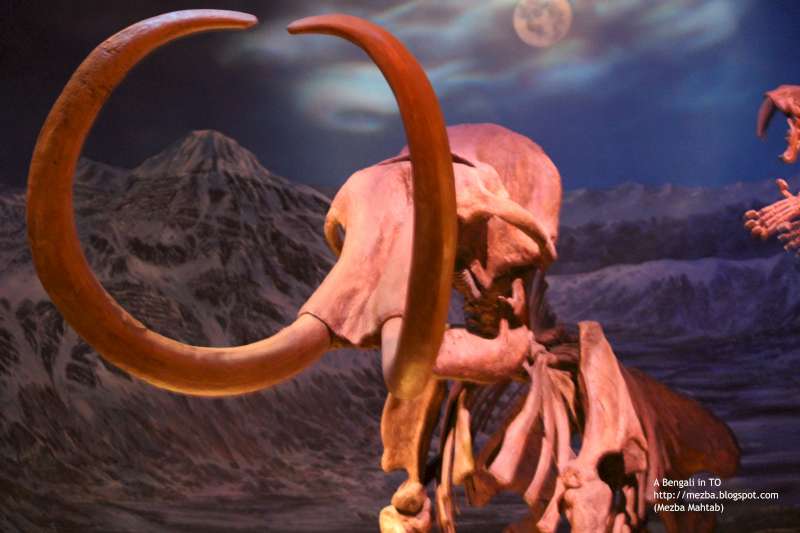
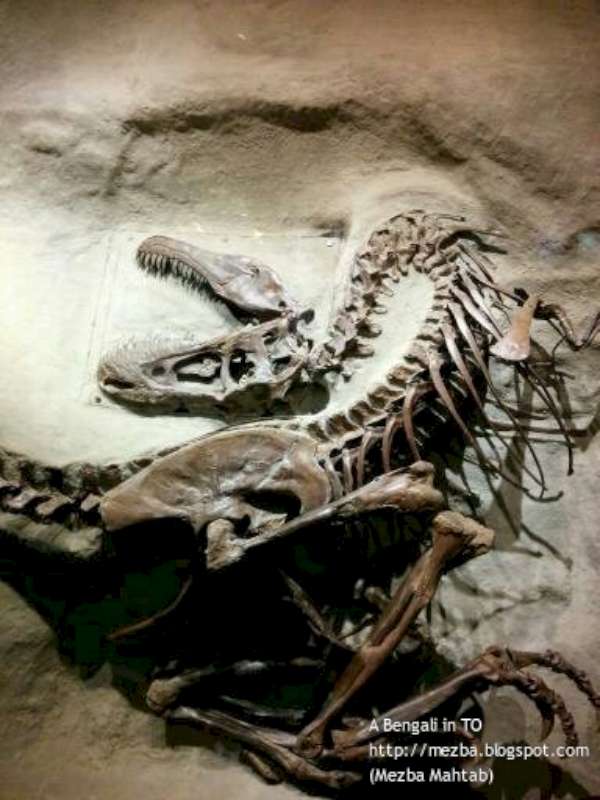
An exhibit at the Royal Tyrell Museum

Ever since 1889, when the first fossil of an  Albertosaurus, a smaller cousin of the famous T-Rex, was discovered, more than 400 dinosaur skeletons have been found here, representing over 55 individual species. No other area of comparable size anywhere has yielded such a large number and diversity of dinosaur fossils.

And of course, when you have such a rich diversity of dinosaur fossils, there has to be a museum.


The Royal Tyrell Museum is a huge tourist draw (and the main draw of Drumheller). There's over 130,000 fossils here, and the museum is huge.


More than 4,400 square metres (47,000 sq ft) of the museum's 11,200 square metres (121,000 sq ft) is dedicated to exhibits.


There's even perfectly preserved specimens of dinosaur eggs! The theme of the museum is a series of chronological galleries celebrating the 3.9-billion-year-history of life on Earth.


One of the most popular is "Dinosaur Hall", with over 40 mounted dinosaur skeletons, including specimens of the famous Tyrannosaurus Rex and Triceratops.


Of course the museum has an eye on modern mass entertainment, and you get to see the stars of the Ice Age movie series (well, their fossils).

 
Manny?


Why are there so many fossils? We took a guided tour, and our guide told us that the true draw of Dinosaur Provincial Park, however, was in the dirt. 

Dinosaurs walked the Alberta Badlands during the Late Cretaceous Period (around 75 million years ago,) when the sub-tropical climate (in Canada!) nourished lush forests and great rivers that flowed east toward a warm inland sea.

 
"Tropical weather? In Canada? You don't say!"

The environment provided homes for a variety of creatures big and small, including sharks, turtles and crocodiles. Reptiles with wingspans wider than a small plane soared across the skies.


Those great rivers left behind the sand and mud deposits where dinosaur bones were quickly buried and then fossilized, and now form the hills and hoodoos of the Badlands.

 
When the last ice age ended 13,000 years ago, water from melting ice carved the valley where the Red Deer River flows, helping to create perfect conditions for fossil preservation.


You can easily spend 4-5 hours here. There's all types of exhibits, even about Jurassic era plants and microbes. They have activities for kids (and families) to go fossil hunting in the nearby badlands. Kids loved the dinosaurs (in fact my four year old knew most of them, because of Harry And His Bucket Full of Dinosaurs). Who said TV wasn't educational?

You will see dinosaurs (well, models of them) all over Drumheller.


The other big attraction (and I mean big) of Drumheller is the World's Largest Dinosaur.


This is a giant model of a Tyrannosaurus Rex (even larger than the known sizes of an actual T-Rex, approximately 4.5 times larger). The height is 26.3m, and you can climb the 106 stairs (for a fee).


It's situated in a park (with water fountains and splash pads) with free parking nearby. By the way, having a giant model of something in the middle of a small Canadian town is an unusual but common Canadian tradition.

Drumheller is a day trip from Calgary. You start in the morning, explore the Royal Tyrell Museum, go to the World's Largest Dinosaur site (most people don't go up, usually), and if you have time go to the Atlas Coal Mine, and then head back to Calgary. When making an itinerary, Drumheller's a must on the trip.