Saturday, May 29, 2021

The One With The Friends Reunion

The Friends TV show ended its run on May 6, 2004.

The blog's first post was July 16, 2004.

I had been blogging for 17+ years. And yet, Friends is older than that.


Today, May 27, 2021 - 17 years to almost the day the show ended, HBO Max telecast a special Friends reunion show. Despite the hit-and-miss nature of the reunion show, with its mixed format of an interview, a behind the scenes look at the show, the actual eavesdropping of the casts' reunion, and the cast reading some of their favourite lines, this special reunion show is going to be widely watched. At close to 2 hours, it's definitely struggling to hold your interest. Yet, it's a good mixture of nostalgia and cheerfulness. This is Friends. It is THAT popular. Even now. Especially now.

Why is that?

Though I was slightly younger than 20 when Friends began, I soon caught up. The TV show Friends is supposed to be about that time of your life when your friends are your family i.e. your 20s. And I can say that I thoroughly, really, absolutely, enjoyed my 20s. I had a blast. And I was at that perfect stage of life where I could relate to the show - they were showing the good times with friends that I, a person in my 20s, was having. If I could go back in time to that time, I would tell my younger person one thing.

Savour every moment. Enjoy every moment. It's not going to come back. It'll never be like this again. 

(And oh, buy Apple and Google stock.)

The 20s are that stage in your life when you are unshackled from the responsibilities of education and college, and yet have to take the responsibility of an adult, while still remaining young and energetic to have fun, and you actually have some money to spend to enjoy that fun. The first crush, the first love, the first heart ache. All of that. It all seems to be so innocent a time. A simpler time. Yet, we know ... a lot was going on.

All that emotion, the feelings, the drama comes packaged into this show, and this is even before we get to how GOOD the show was.

The show was perfectly CAST. Every actor was their character and you cannot imagine any other person playing those roles. The writing was fantastic. It was funny, it was good physical comedy and never did the show become boring, even during the tenth season's Rachel-Joey segments. The chemistry amongst the cast was really there to be seen. People often compare Friends to How I Met Your Mother. While HIMYM had its good moments, it started to tank after season 6 or so. Friends however maintained that good writing and the standard throughout its run. And partly I think because of its competitors - Frasier and Everybody Loves Raymond - each brilliant shows in their own way.

So how was the Reunion episode?

Even if it was not that good, it was still good. But it did highlight one thing.

Aging.

Everyone ages. Some better than others. Some, not so good. And for others, there's always Botox.

This is something we don't like to admit to ourselves. We who watched Friends live in our 20s are now in our 40s. The TV may still show those characters as they were, but that's not who the actors are now. It was tough, for example, to see Matthew Perry. His struggle with substance abuse and addition are now well known. It's a reminder that whatever your youth may be, sometimes life takes you down a road that's different from others. Bad things happen. Suddenly the cheerful world of one's 20s is not so cheerful any more. Your responsibilities may start to weigh down. Things may not look so promising.

Welcome to your 40s. 

And that's why people tuned in to this show. It was a reminder of simpler times. Before social media, smart phones, and before a global pandemic. And yet, I felt at times, the reunion show dragged. The stars' conversations seemed forced. They harped on about their chemistry and the good times they had as if to remind us. Could they BE any more rehearsed? And what was the whole point of having Malala Yousafzai or David Beckham on the show. 

Yet, just like a Friends episode (or a pizza slice), even if it was bad, it was still good. The show was both scripted and unscripted. It was long and dragging, but still managed to entertain. It serves up a heavy dose of nostalgia to a time before the present, when all was good in the world, simply due to the brilliant and stellar cast who, after 17 years, still slips back so comfortably into their roles that you don't feel like they had taken a break. It is comfort food, and it is fine dining. 

After all, since March 2020, when we feel like we are stuck in second gear, when it hasn't been our day, our week, our month, or even our year ... this show reminds us of a time when our friends were there for us. 

Friday, May 21, 2021

Gays, Homosexuality and Islam

Let's talk about gays, homosexuality and Islam. 

One of the big, BIG, mistakes Muslims make is assuming our position is the SAME as that of fundamentalist (or Evangelical) Christians, or orthodox Jews. Similar to the debate on abortion, evolution - Islam has its own take. Some similarities, but also a LOT of differences.

First and foremost, Islam does not deny the existence of gays (unlike a former President of Iran).  Even during the time of Prophet Muhammad pbuh, there used to be people called Mukhannathun (effeminate men). Ladies did not even observe hijab from these men and many senior female Companions employed them as servants. These are mentioned in several hadith.

Second, scholars also note an important distinction on the curse applied to Mukhannathun (and those who cannot be employed by women). This only refers to those mukhanathun who are pretending and not actually lacking desire for women. As for those who are not pretending, they are allowed to enter upon women. Similarly, Islamic scholars like Ibn Hajar al-‘Asqalani stated that all mukhannathun must make an effort to cease their feminine behavior, but if this proved impossible, they were not worthy of punishment. Those who made no effort to become less "effeminate", or seemed to "take pleasure in (his effeminacy)", were worthy of blame.

So you can already see that there is an acknowledgement of gays (and by extension lesbians) in early Islamic history, as well as rulings on acceptable behaviour. Punishments of gay behaviour used to be for public displays of lewdness, but not private sins (unless publicly admitted), and used to differ from Caliph to Caliph. There was also an attempt made to distinguish between nature (what you naturally are) and nurture (what you attempt to become). The later Umayyads persecuted these people (but to be honest, the later Umayyads persecuted everyone). There is rich history of them mentioned in Arabic literature, particularly during the Abbasid era.

Now to the most important ruling - what is Islam's stance on homosexuality? 

It is evidently clear and precise. The homosexual act is to be condemned; it's a sin and an abomination, as evident from the Quran. There is no ambiguity in it. The story of the Prophet Lut (Lot) is mentioned in the Quran, and although it differs from the Bible in crucial details, it has the same moral message. 

Here is another difference. The ACT itself is haram. It is a sin. 

So if you are gay, and you are inclined to the act, that itself is not a sin, but if you act on your desires, you are committing a sin. If the sin is committed privately and you repent, it is forgiven. As long as you repent genuinely and try to avoid the sin, you are forgiven, EVEN if you fall into the sin from time to time.

The big sin is in public display. So if you are a believing Muslim who has gay inclinations, you are not to announce your sin publicly (to be honest you should not announce ANY sin publicly). You cannot promote the lifestyle, nor can you say it is normal and OK (as that would be disbelief in the Quran and take you out of Islam). It is considered a big test and everyone is tested differently.

Note this does not cover trans people or intergender people, whose cases are different. Again, that's a separate topic, but it IS covered in Islam. One madhab, for example, allows a trans person to choose his or her gender differently to what they normally express as during times of inheritance. 

If you are a modern, secular person, obviously you will have a lot of disagreement with the various parts of this writing, as you do not believe homosexuality to be a sin. That is fine. To you is your religion.

If I have made any mistakes in this writing, it is mine. Please do your own research.

Sources:

  1. Effeminates of Early Medina
  2. Islamweb fatwa on who the curse applied to
  3. an-Nawawi. "Al-Minhaj bi Sharh Sahih Muslim". Shamela. Archived from the original on 17 August 2018. Retrieved 14 October 2018


Sunday, April 11, 2021

Port Perry - A Good Day Trip Option from Toronto

About 85 km north east of downtown Toronto, or about 40 km away from Scarborough, lies a small community in Scugog, Ontario called Port Perry. Port Perry serves as a hub for many small communities in the Scugog area. Located at the basin of the Trent-Severn Waterways is Lake Scugog, one of Ontario's largest man-made lakes. Port Perry was used briefly as a small town in New Hampshire during the sixth season of The West Wing.


On a warm, nice, sunny day, the marina and waterfront of Port Perry can be a nice spot to walk or have a small picnic lunch. Port Perry's Victorian-era downtown is a tourist destination, with clothing stores, restaurants, cafés, bookstores, galleries and antique shops.


The Lake Scugog shoreline offers two popular lakeside parks, Palmer and Birdseye. We visited Palmer park recently. The big red structure in the photograph below is The Port Perry mill and grain elevator, circa 1930. Originally built in 1873, the building remains a major landmark to this day. The original line of the PW&PP Railway can be seen in the foreground.


Lake Scugog is also known for fishing. There are active fishing seasons, both winter and summer. In the winter months, Lake Scugog is dotted with ice-fishing huts and is a destination for ice fishermen and snowmobilers. However, in recent times, you cannot fish for Walleye anymore. As you can see in the sign below, the levels of this magnificent fish has fallen so low, that fishing for Walleye is no longer permitted.


Of course, as these are COVID-19 times, sadly, there are gathering and meeting limits everywhere. Even though most people did not wear marks while outside (and maintaining social distance), masks are currently mandatory when you are inside any business establishment.


In the summer, this is also a favourites place to launch boats from. The Trent waterway system is the gateway to many lakes and small rivers.


All in all, on a nice, sunny, warm day, Port Perry waterfront offers a great place to have a small picnic, a day trip from Toronto, and a small vacation without much hassle. 

You can bring your own lunch, or grab some fish and chips from one of the few places nearby, and watch the activities on the pier. Here's hoping we can soon fight covid-19 off and can enjoy these places properly, as they are meant to be.

Thursday, April 08, 2021

Sibbald Point Provincial Park (in the Spring)

 Sibbald Point Provincial Park is a mid-size provincial park about 1 hour north of Toronto.

This week (from today, Thursday) the new provincial stay-at-home order comes into effect as Ontario fights the 'third wave'. Last weekend, my family and I decided to visit this park, given that it was a warm spring day (15C!) and there is nothing much else to do in these lockdown times as we wait for the vaccine and a return to normalcy. 

The attraction of this park is a large sandy beach on Lake Simcoe.


The water is very clear, as you can see, but it was colder near the water. 15C can feel like 10 or even 5 as you get close to the cold water, so you really need to prepare accordingly. There are lots of grassy areas for picnics (and even some picnic benches).


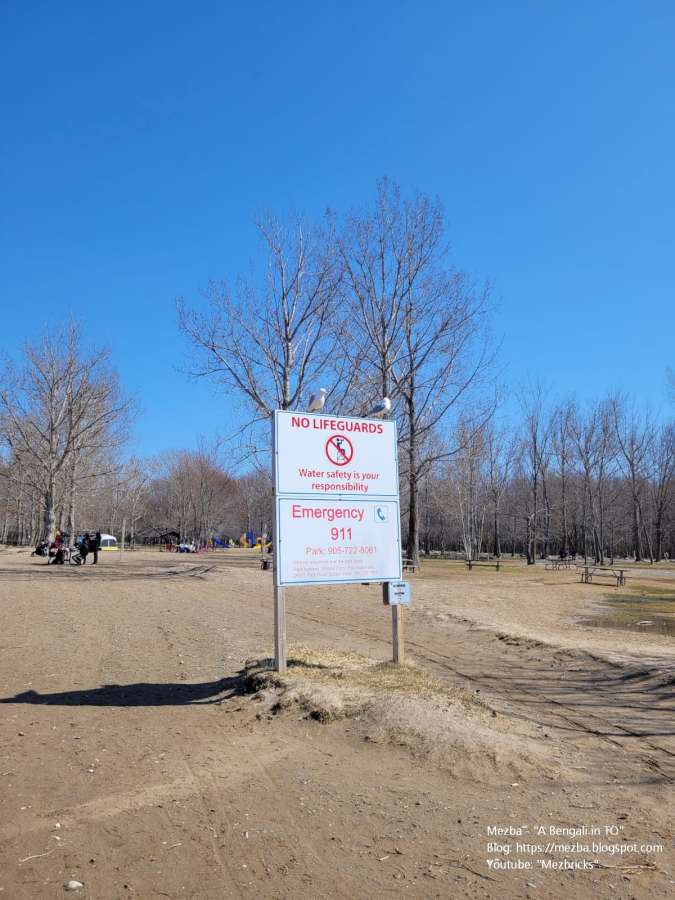
As usual, there was no lifeguard. In fact, there was no one at the entrance to the park. You take an envelope from the entrance booth, put your daily usage fee there (in cash) and then close the envelope. There's a piece you can tear off to put on your dashboard as your parking permit, and you put the envelope in the deposit box.

The beach would be really nice in the summer. Since it's Lake Simcoe, you can fish from the shore for perch (and later, bass). There's a forested hiking trail as well.


In the picture above, you can see some of the embankments from the beach. These are huge bunch of irregular large rocks that are in place that you can walk over to go deeper into the lake. 

Of course, when you reach that pathway, you are warned that these rocks are slippery (they are, obviously, wet from the waves). And remember, no life guards.


However, it's not really that difficult, and even my 6 year old had no difficulty navigating the rocks (with a little bit of help). Do have extra pairs of socks for the kids if you are going to do this in the spring!


The water was so clear. So blue. It looked so nice and refreshing.


It's not hard to imagine how it will be in the summer on a hot day. I just hope we can get through this pandemic by then, and get vaccinated, so we can enjoy a proper summer.

Thursday, April 01, 2021

Reptilia Zoo in Vaughan, Ontario

In these Covid19 times, it is hard to schedule activities for children. We are home all the time; we cannot visit friends and relatives; in-person school is now closed. Wondering where we can take the kids, my wife stumbled upon Reptilia Zoo.


Reptilia is Canada's largest indoor reptile zoo, with 25,000 square feet of indoor exhibits featuring over 250 reptiles, amphibians and arachnids. 


Currently there are two Ontario locations, one in Vaughan and one in Whitby. We decided to visit the one at Vaughan. The social distancing protocols were very good. Masks were mandatory (of course!) and they gave us a time slot for the visit. When we went there, we shared the whole museum with only 3 or 4 other families.


I was really surprised at the number (and variety) of animals there. Although it's not a very big place, if you take your time to enjoy each exhibit, you can easily spend an hour or a couple of hours there, especially if you are into photography.


They had quite a number of large crocs (or were they alligators) on display. It's hard to imagine, just looking at them as they just stayed there, lazily bathing in the heat lamp, that these were ferocious creatures who could move fast if needed.


There were also quite a large number of tortoises (both small and large) on show. In addition to spiders, tarantulas and other creepy crawlies. 


The snake exhibit was one of the ... longest .... no pun intended. They even had an anaconda, along with various species of pythons and other common snakes. 


We were actually lucky to be there around feeding time, so we actually saw how a snake eats a mouse! Poor mouse. 


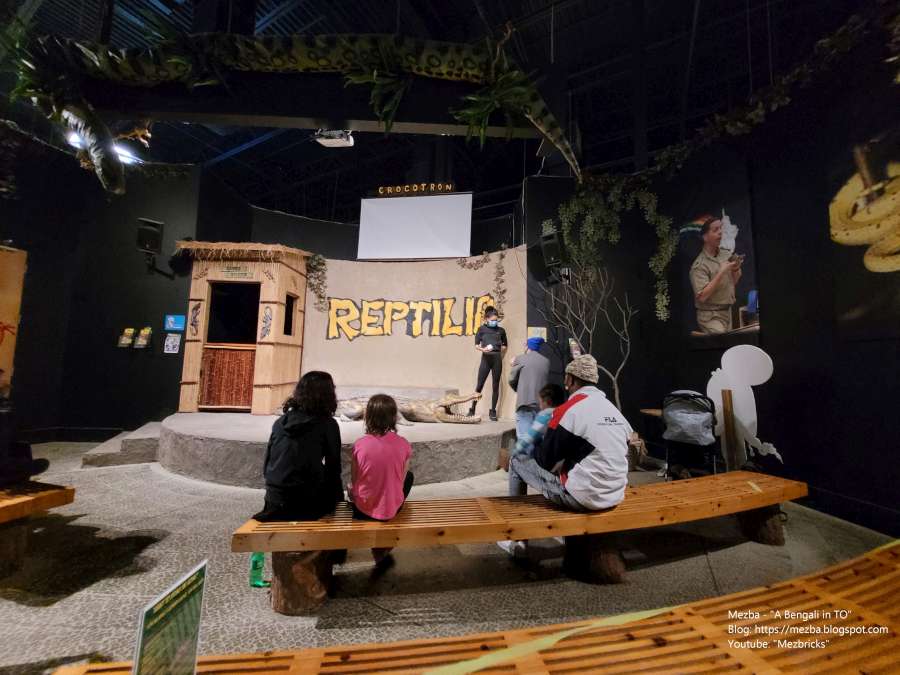
Another large crocodile surfaces from under the water in a large tank. This was next to the place where they had live shows. In normal times, you would touch and pet some (small) reptiles, but due to covid times it was only "see but don't touch" show.


The odd thing was, during the live show, there was actually a marriage proposal! The zookeeper who was conducting the show asked one of the ladies to come join her on stage, and then she was asked to pick a small box from a tray. There was a diamond ring inside, and then that lady's boyfriend went down on one knee to propose!

She said yes, by the way.

Also, given that they already had a kid together (they had a baby in a stroller), the risk of a no is minimized, I think. 

The guy is smart. Proposed at a reptile show, and will marry during covid times. Saved a lot of money.


These are the general show times, and feeding times (they can change, of course). If you do visit, try and schedule your visit around a feeding time.

Overall, this was a great place to take your kids (and your camera). It's not too expensive (especially if you book online), and is a great way not only to spend some time, but also to support your local businesses during these tough times.

Monday, March 29, 2021

Why do Australia and New Zealand perform much better than other Western countries in the Coronavirus pandemic?

Is it because these two countries are essentially islands which are far away from continent in the north?

No. It is just down to good common sense governance, something that eludes this current Liberal government. Let me show you a recent example.

Some time ago, it was announced that a security guard who was patrolling a quarantine hotel has been diagnosed with COVID. The highly contagious UK variant. He was the first person in 10 months in Western Australia to contract the virus.
Based on this news, the premier immediately locked down the majority of the state. EVERY THING was shut down, a mask mandate was instructed, and testing facilities heavily staffed with increased opening hours. Record numbers of people turned up to testing stations, and everybody was wearing a mask in public. Hours were spent tracking, tracing, and isolating close contacts - some of which are put in hotel quarantine as a precaution. Hundreds of close contacts were found and tested. This was possible due to the mandatory “check in" register that has been in place (via the Covid19 app). Close contacts can be traced very quickly.
After a 5 day hard lockdown, there were no new cases. Brilliant management and now the state is out of lockdown again. No more restrictions, everything fully open.
So from this extract, we can deduce the following as to WHY Australia and New Zealand do very well with the corona virus management:
  • All incoming travellers are quarantined in guarded hotels and tested twice before release. This has been the policy since April 2020. The Liberal government of Canada started this in Feburary 2020, and that too in a rather haphazard and inefficient manner.
  • Testing is available to all, at any time. Again, the policy since April 2020. In Canada, the provinces were left on their own. Ontario, for example, only tested if you have severe symptoms, early on during the epidemic, allowing it to spread.
  • Contact registers are in place to be able to contact trace, isolate and test very quickly and efficiently. In Canada, it depends again from city to city. Toronto has essentially given up on contact tracing.
  • Both Australia and New Zealand have very proactive leaders who will take very firm and sharp action with no notice. In Canada, we have Justin Trudeau, who relies on Dr Tam. Nothing more to be said.
  • Both Australia and New Zealand have a very compliant population who will follow advice and instruction for their own benefit. In Canada, we HAD that. From March 2020 to July 2020, we had a very compliant population, but the politicians wasted that goodwill.
  • Their leaders are willing to spend whatever amount of money it needs to contain this virus. They know that it will be repaid many fold as businesses etc. can remain open if the virus is eliminated. In Canada, we are also prepared to spend money. But most of it is wasted since we are not planning to eliminate the virus, just "manage" it.
What Canada doesn't understand, and what New Zealand and Australia understand very well, is that there is no difference between 1 case and 1000 cases. 1 can lead to 1000 in hours. This is something Canada never accepted. We are happy with being mediocre.

Friday, March 26, 2021

Why East Pakistan Became Bangladesh: The Final Part (Part 4) - Military and Politics

Why East Pakistan Became Bangladesh (Part 4)

Part 1- Economic Exploitation of the East

Part 2: Language and Culture

Part 3: Cyclone Bhola

The Final Part (Part 4): Military and Politics

In this series of posts, I will highlight just a few of the many reasons why East Pakistan seceded from Pakistan and became Bangladesh. 

The Final Part (Part 4): Military and Politics

When Pakistan came into being in 1947, it inherited 6 infantry divisions and 1 armored brigade from the British Indian army, ALL of which was based in West Pakistan. East Pakistan was later allocated a few battalions. Over time, as the Pakistan army exponentially grew, West Pakistan continued to receive over 90% of the armed forces. There was little to no air force or navy present to defend East Pakistan.
The defense of the East lies in the West .
This mantra, that the Pakistan army does NOT NEED TO DEFEND East Pakistan, formed the core of Pakistan army's strategy. Broadly speaking, this translated into Pakistan defeating India in the west, regardless of what transpired in the east (including Indian occupation of East Pakistan) because the presumed West Pakistani success would force India to negotiate a favourable settlement.
So Bengali Pakistanis became increasingly frustrated. They were asked to lay down their lives in defending West Pakistan, yet the Pakistani army wasn't prepared to defend them. The Pakistan army was also composed of 90% West Pakistanis, despite Bengalis making up 56% of the population of Pakistan.
During the two wars with India, East Pakistan was left virtually defenseless. Bengalis died preventing India from taking Lahore, while their own homes in East Pakistan were left open to attack, had India wanted to. This ultimately led to Sheikh Mujibur Rahman of the Awami League proposing the famous "6 point formula" in 1966 in Lahore. It, amongst others, demanded almost full autonomy for East Pakistan in most matters.
Political Subjugation
From 1947 through to 1971, the political suppression of Bengali Pakistanis continued on a systematic scale.
  • Whenever a Bengali Pakistan was elected as Prime Minister of Pakistan, such as Khawaja Nazimuddin, Mohammad Ali Bogra, or Huseyn Shaheed Suhrawardy, the West Pakistani establishment would quickly depose of that person.
  • As most Pakistanis were Bengalis, a system of direct representation would favour them, thus the leadership of West Pakistan came up with the idea of "One Unit". West Pakistan was "one unit", as was East Pakistan. Pakistani scholars and researchers maintain that the One Unit programme was viewed as a counterbalance against the political and population domination of the ethnic Bengali population of East Pakistan.
  • We have already talked about the economic, cultural and language oppression policies of West Pakistan towards their brothers in the East in previous segments.
  • Finally, in 1970 General Elections, the Bangladesh Awami League, the largest East Pakistani political party, led by Sheikh Mujibur Rahman, won a landslide victory in the national elections. The party won 167 of the 169 seats allotted to East Pakistan, and thus a majority of the 313 seats in the National Assembly. This gave the Awami League the constitutional right to form a government. However, Zulfikar Ali Bhutto (a former Foreign Minister), the leader of the Pakistan People's Party, refused to allow Rahman to become the Prime Minister of Pakistan. Instead, he proposed the idea of having two Prime Ministers, one for each wing.
  • This was the final straw. Bengalis now knew that EVEN IF THEY played by all the rules, and legitimately won, their aspirations would be crushed and their dreams squashed. Thus Pakistan could no longer remain united.
Events Leading to the Declaration of Independence
Events then began to move fast.
  • On 7th March, Sheikh Mujubur Rahman gave his famous speech at the Racecourse.
  • The Pakistan army began to fly soldiers into East Pakistan, disguised as civilians.
  • General Tikka Khan, known as the "Butcher of Baluchistan", was flown into Dhaka to become Governor of East Bengal. East Pakistani judges, including Justice Siddique, refused to swear him in.
  • "Operation Searchlight" began on March 25, 1971. Before the beginning of the operation, all foreign journalists were systematically deported from East Pakistan.
  • The violence unleashed by the Pakistani forces on 25 March 1971 proved the last straw to the efforts to negotiate a settlement. Following these incidents, Sheikh Mujibur Rahman signed an official declaration of Independence:

    "Today Bangladesh is a sovereign and independent country. On Thursday night, West Pakistani armed forces suddenly attacked the police barracks at Razarbagh and the EPR headquarters at Pilkhana in Dacca. Many innocent and unarmed have been killed in Dhaka city and other places of Bangladesh. Violent clashes between E.P.R. and Police on the one hand and the armed forces of Pakistan on the other, are going on. The Bengalis are fighting the enemy with great courage for an independent Bangladesh. May Allah aid us in our fight for freedom. Joy Bangla."

Thus was born Bangladesh.

Sources:
  1. Major Nasir Uddin, Juddhey Juddhey Swadhinata, pp47
  2. Ali, Maj. Gen. Rao Farman, How Pakistan Got Divided, pp114
  3. A Tale of Millions, Rafiqul Islam
  4. Sayeed, Khalid B. (1967). The Political System of Pakistan. Houghton Mifflin. p. 61.
  5. Talbot 1989, p. 86.

Why East Pakistan Became Bangladesh: Part 3 - Cyclone Bhola

Why East Pakistan Became Bangladesh (Part 3)

Part 1- Economic Exploitation of the East

Part 2: Language and Culture

Part 3: Cyclone Bhola

The Final Part (Part 4): Military and Politics

In this series of posts, I will highlight just a few of the many reasons why East Pakistan seceded from Pakistan and became Bangladesh. 

Part 3: Cyclone Bhola

Is it possible for a hurricane to physically split apart a nation? 
In this segment I want to highlight the effect of Cyclone Bhola on East Pakistan and the subsequent events. Before that, let's set the context.
Ever since 1947, East and West Pakistan has been uneasy bedfellows. Initially the fear of Muslims being dominated by a Hindu India kept the two wings together. By 1970, the military had been ruling Pakistan with an iron fist for 12 years. Strikes, riots and civil unrest was a daily fact of life. Elections were promised but delayed due to floods. And then came Tropical Cyclone Bhola.
Bhola remains the deadliest tropical cyclone ever recorded, and one of the deadliest natural disasters.
Bhola is often compared to the 2004 Indian Ocean Tsunami in its devastation:
- More than half a million people in East Pakistan lost their lives.
- Over 3.6 million people directly affected by the cyclone.
- Total damage is over $86.4 million (1970 USD, $450 Million 2006 USD).
- 65% of the fishing capacity of the coastal region was destroyed
- Survivors were at risk of cholera, typhoid and small pox for upto three months.
- People ate tree roots and drank water from ponds in which corpses were rotting because they had no other choice.

The Response of the Pakistan Government
Faced with such a catastrophic natural disaster, the government of Pakistan had a moral duty, and a golden opportunity, to demonstrate to the citizens of East Pakistan that Pakistan cared about them and their well being. Instead, everything that could go wrong, did go wrong. 
Whether by a genuine lack of concern from West Pakistan, or just genuine incompetency, or likely some combination of both, the response of the government to the disaster was a disaster in itself:
- About 3 weeks before the Bhola Cyclone there was a much smaller cyclone that had hit on October 23rd. The Pakistan government sent out evacuation orders, however, the storm dissipated. Because of this previous cyclone, government officials decided to not send out evacuation orders for Bhola.
- The government issued a warning of the approaching hurricane ... AFTER the hurricane had already made landfall, leading to people caught unaware.
- Only one military transport aircraft and three crop-dusting aircraft were assigned to relief work by the Pakistani government. They blamed India for not allowing flights across Indian air space, a charge the Indian government denied.
- A pesticide company had to wait two days before it received permission for two of its crop dusters, which were already in the country, to carry out supply drops in the affected regions.
- The Pakistani government only deployed a single helicopter to relief operations.
- Pakistan and India, due to their rivalry, did not share weather data which prevent warnings from given to East Pakistan coastal areas.
- The hurricane struck land on Nov 12, but the leader of Pakistan, Yahya Khan, only visited the areas on Nov 16. Despite criticism of efforts, he only took charge of relief operations on Nov 24.
- A reporter for the Pakistan Observer spent a week in the worst hit areas in early January and saw none of the tents supplied by relief agencies being used to house survivors.
- West Pakistani newspapers constantly downplayed the affects. Despite receiving reports of 500,000 dead, the Pakistan Observer on Nov 13 had the headline: "50 feared lost".
As the magnitude of the disaster became more and more clear, as did the inadequate response by the government, anger and unrest spread among the survivors. All political parties of East Pakistan issued a united statement harshly criticizing the government of Pakistan. Each politician wasted no time in telling the people how the Centre had bungled the efforts.
The entire political atmosphere had now changed dramatically.
No longer were East Pakistanis content with a return to democracy. With the disregard shown by the Yahya government towards the victims of the cyclone, not only did East Pakistani politicians demand the leader's resignation, but people openly called for what had hitherto been left unsaid: the breakup of East and West Pakistan. It was now only a matter of when.

To Be Continued ...

Sources:
1. 1970 cyclone changes the course of history. (2010, November 06) Retrieved November 11, 2017, from https://thisinnocentcorner.wordpress.com/.../1970.../
2. 1970 - The Great Bhola Cyclone. (N.D.). Retrieved November 1, 2017, from http://www.hurricanescience.org/.../storms/1970s/greatbhola/
4. Zeitlin, Arnold (January 13, 1971). "Pakistan Cyclone Relief Still Jumbled and Inadequate". Long Beach Press-Telegram. Associated Press. p. P-11. Retrieved April 15, 2007 – via Newspapers.com
5. Durdin, Tillman (March 11, 1971). "Pakistanis Crisis Virtually Halts Rehabilitation Work in Cyclone Region". The New York Times. p. 2.