Tuesday, September 06, 2022

Sudbury - Day 2 - Dynamic Earth and Onaping Falls

Continued from Day 1 ...

After having spent time in Parry Sound, we drove on to Sudbury, an hour and half drive north. Not too many know, but Sudbury is the largest city in Northern Ontario by population. By land area, it is the largest city in Ontario and the fifth largest in Canada.

Sudbury was once a major lumber center and a world leader in nickel mining. Mining and related industries dominated the economy for much of the 20th century. It is that mining history that we will take a look at, as we visit Big Nickel, and Dynamic Earth.


The Big Nickel is a nine-metre (30 ft) replica of a 1951 Canadian nickel, located at the grounds of the Dynamic Earth science museum. It is the world's largest depiction of a coin.


It was now time to visit Dynamic Earth.


Dynamic Earth is an interactive science museum in Greater Sudbury, Ontario, Canada. It is a MUST VISIT if you are in Sudbury.

Did you know there are 4,800 kilometres of mines beneath and surrounding this city. That’s enough tunnel to stretch from Quebec City to Victoria.


Owned-and-operated by Science North, Dynamic Earth is an earth sciences museum which builds on the city's mining heritage, focusing principally on geology and mining history exhibitions. 

One of the problems of the website (as of time of writing of this article) is that you cannot book English language tours reliably. So your best bet is to visit the museum when it opens to get tickets for a tour. Definitely take the tour including the mine visit.


The tour starts with a seven-story elevator ride descending to a cavern. The mine's temperature are averages at 13°C (55°F) all year long. 


Then the tour goes through a demonstration mine to showcase the evolution of mining from turn-of-the-century to modern day. Here, we see various uniforms of miners (based on their roles), hung to dry near the lamps. In the early twentieth century, miners had to pay for most of their own equipment, and clothes, and these needed to be washed and dried every day.


As you step into the underground chamber, you need to select and put on hard hats (helmets). There's children sizes as well. I don't remember if you can take a stroller here, but I don't think it is advisable. If you have to carry a toddler, you shouldn't really be doing this tour. But with children who can walk, and especially who knows a bit about mining (perhaps from the game Minecraft), this is a must do.


Does it get cold inside? Slightly. We went on a hot summer's day (it was 32C outside), but underground was a cool 15C. We were fine in the beginning, but by the end of the tour (about an hour long), we began to wish we had brought a slight jacket for the kids.


Flipflops are also not a good idea. I normally wear sandals in the summer, but took care to wear sneakers, and boy was I glad. It IS a mine, just not a working one (thankfully lol). 


The tour guides keep it highly entertaining. It is also amazing to hear of how little was done in terms of safety a hundred years ago. Children as young as 10 or 12 used to work in the mines, sometimes preferred because they could climb into small pipes to dislodge rocks and boulders. And if they didn't get out of the way in time ... too bad. You read about such stories in Charles Dickens, and here you see examples of it.


The tour explains how standard slowly shifted as time went on, and more and more safety measures were put in place. There was also a (simulated) explosion showing how mines used explosives. The kids loved that experience (and so did the adults).

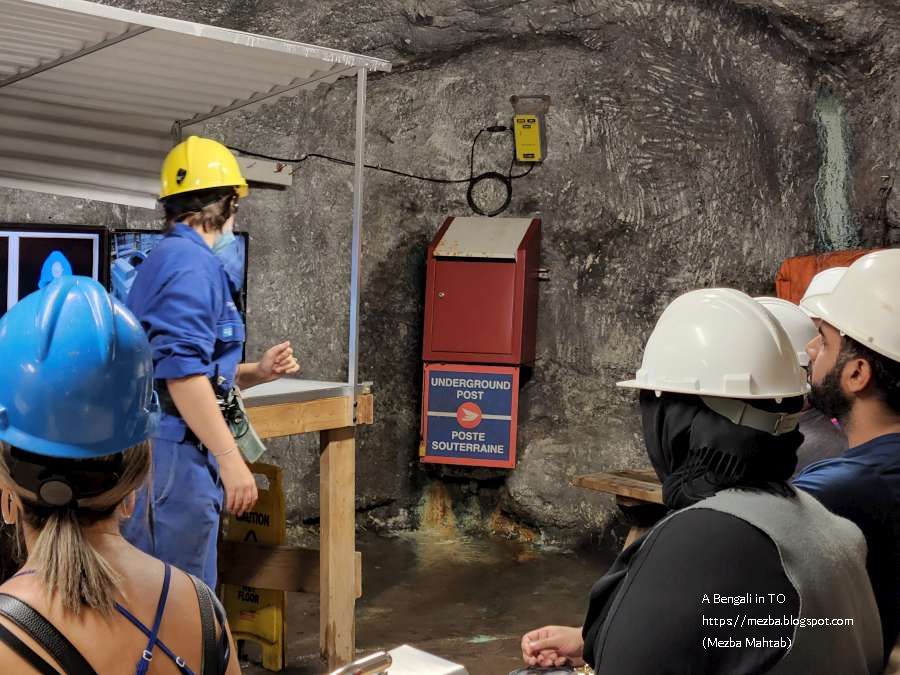


We also visited a Refuge Chamber (also known as Refuge Stations). These are sealed, secure, accessible rooms that preserve life through the monitoring and management of essential gas levels for underground mining. If something happens in a mine, such as a collapse, or power outage, you need to rush to these rooms. The guide told us about the Chilean miners, and how they stayed in one such room during their ordeal. 

She also assured us this was the deepest working Canada post letter box.


Overall, this was a highly educating, entertaining and somewhat different type of museum tour than what you normally are used to. I would highly recommend Dynamic Earth and the mine tour to anyone visiting Sudbury.

After lunch, it was time to visit Onaping Falls.


Onaping Falls is the name of a small town about 30 minutes drive from Sudbury, and the main attraction there is the eponymous Onaping Falls.


If you are with family that includes kids and seniors, you want to drive to the AY Jackson visitor centre site. You can park the car there, and take in the beautiful sight of the falls.


Unfortunately, some people still trying to express themselves with spray paint. Hopefully the officials can deter them and clean up.


If you want the best views and a good hike park down the road at alt parking and walk up the sand hill.


Alternatively, there is a 5 minute (or less) walk and you will see the falls from a distance. The first lookout is stroller-friendly, after which there's a lot of rocks if you wish to continue.


Onaping Falls is the place you can spend a couple of hours easily. I am told it's even better in the Fall when the trees get full colors in middle of October, and with no mosquitos to boot. Just walk up to any convenient place and watch.


We would head back to Toronto tomorrow. There's a couple of other places in Sudbury, especially for the evening, if you want to roam about. Bell Park is one. For us, we were still giddy about visiting a real mine.


Monday, August 29, 2022

Parry Sound and Sudbury - Day 1 - The Thirty Thousand Islands Cruise

Parry Sound is a town in Ontario, Canada, approximately 2 and half hours away. We had a weekend to ourselves, and decided to visit Parry Sound, and then the mining town of Sudbury.

Parry Sound is the birthplace of hockey legend Bobby Orr, the namesake of the local community centre and the town's own Bobby Orr Hall of Fame. It also sits on the glorious Georgian Bay, which is the northeastern arm of Lake Huron, in Ontario, and home to 30,000 islands. We booked a cruise that was similar to the Thousand Islands cruise in Kingston

Leaving Toronto early in the morning, we got to the cruise by around 1030 am, which was perfect weather. The cruise was departing in half an hour, so we had enough time to park, freshen up and then board the ship.

It was crisp summer weather. Blue skies, hint of clouds, and perfect hot temperature for a cruise. The town itself was buzzing, and it is easy to see why Parry Sound is so popular a destination for water sports. 


The Wasauksing Swing Bridge is a bridge that has vehicular traffic, but also swings open to allow passage of boats.


It was a three hour cruise that we booked. As I said, it is very similar to the Thousand Islands Cruise in Kingston. If I had to choose between the two, though - I would choose the Kingston cruise, as there is a little more variety, as well as the castle.


The audio narration on board was nice, and kept you suitably informed about various points of interest, such as this place where huge birds of prey would nest.


Overall, it was a lovely day for a cruise. Since it's three hours, remember to take some cards or games to keep yourself entertained after the half way mark, as things will get monotonous. And food! There is an onboard restaurant, but nothing beats a picnic on a boat.


The cruise also takes you past Killarney Provincial Park - a fantastic park home to beautiful campgrounds and beaches. We even saw some people dive off this "cliff" !


There is a small seaplane airport (seaport?) in the marina, so after your cruise is over, you can stay on the docks and watch the planes "land" or take off.


Overall it was a lovely day, and after a late lunch, it was on to Sudbury, another hour and half away.

Wednesday, August 03, 2022

Sunflower Farm, Markham

In a little farm in Markham, Ontario, just north of Toronto, we found a gem.


This is Sunflower Fields of Markham. Their website is https://sunflowerfieldsofmarkham.ca/ and contact number is (416) 859-6159 .


The farm's sunflower fields were massive. There were many rows of these tall flowers, and almost all of them in perfect health. 


It was the beginning of the season, I guess, so the flowers were perky and upright. We also visited around 2 pm, so the sun was nice and high, and the weather clear, with blue skies and some clouds to make it a great weather for taking pictures.


The farm had a few props such as a couple of swings, an old tractor, and a hoe (I am guessing it's a hoe - no, not that kind of hoe).


Even though we visited on a long weekend, I didn't find it quite crowded, and we were able to take pictures in peace. Usually in some of these farms, there's quite a few instagrammers, and you really get tired of waiting as they take thousands of shots to get the perfect one.


There were also quite a lot of haystacks placed here and there, so you can sit and take pictures. 

Overall, there are many sunflower farm in and around the GTA nowadays - with social media being what it is. This is one of the better ones, as it's close to the east end of the city, not too far, and not too crowded. They need to put a few wagons in there as props, and it will be perfect.

Sunday, July 24, 2022

TD Festival of South Asia, 2022

 The TD Festival of South Asia is a free street festival in Gerrard India Bazaar celebrating South Asian (OK mostly Indian) culture, food, entertainment and heritage.


They close off Gerrard street for the Indian section, and even the streetcars are rerouted. It is more or less an excuse for many of the businesses here to display their wares in the street. Gerrard street (the India Bazaar section) was known back in the day (late 90s, early 2000s) as the South Asian place in Toronto. That distinction, of course, has been lost over the decades as the South Asian diaspora spread far and wide, and now no one really needs to go Gerrard any more for their desi stuff.


The food choices were many. There were multiple stalls selling appetizers such as samosas or cane juice or mango lassi, as well as regulars such as chaat, bhelpuri and so on. The line ups weren't that long in the afternoon, and the prices reasonable.


The eastern section of the plaza contained more diverse choices such as street BBQ-ed tandoori chicken (check out the red colour!) as well as cholay batoore and others.


Of course it cannot be a festival without performances, and to their credit, the organizers had some set of dancers or performers every so often. And they were not just Indian - I saw Nepalese, Bengali amongst others. So at least in that aspect, it covered the whole South Asian flavour. 


I heard there was another festival in Mississauga, which is rapidly becoming another South Asian centre, along with Brampton. However with it comes to Gerrard, it is the OG, and many of us have fond memories of our early days in Canada coming down here to get a taste of South Asia in Toronto.


The weather was clear and sunny, and not too hot, which was perfect. You could walk around, see the whole set of bazaars and stalls, while getting tasty bites to eat.

As for parking, you have to park on the surrounding streets. On some of them you can only park on one side of the street (depending on the date) and there are also time restrictions (you can only park for an hour), so do pay attention. I wish there was a Green P location nearby that was easily accessible. However, it was a fun festival to attend.

Saturday, July 23, 2022

Taste of the Middle East, Toronto, 2022

The Taste of the Middle East is a festival that celebrates Arabic music, culture, food, arts and heritage. 

This year the festival was held downtown Toronto, at Nathan Phillips Square.


It was a brilliant sunny day. I visited on Friday, the first day of the festival. It runs Friday, Saturday and Sunday. Apparently there are bigger things planned on Sunday.


Along with the sponsor tents, there were lots of other tents of various merchants. Here is Huda, a religious organization, right next to the telecommunications giant Telus.


In the picture above, City Hall is to the background. Nathan Phillips Square has the advantage of having a huge Green P parking lot right underneath. I got in around 7 pm and got parking easily. It only cost $6.


Lots and lots of stalls, and lots and lots of people. It was great to see the huge diversity that makes Toronto one of the best cities in the world to live in. Everyone came to experience Arabic culture, not just Arabs (or Muslims).


People also have the misconception that Arabic culture is just limited to Muslims and Islam, which is not true. There's a lot of Christians in the Arab world. Some of the Arab world also have other cultures that are non Arab, for example Berbers.


As the evening went on, it became busier and busier, as more people started to drop by. The stage also started to have some shows and performances.


The one complaint I would have is that the food selection was not that big, and as expected from a festival - it was expensive. A pineapple juice drink was $13. A pastry was $8. Osmows shawarma platter was $13. I guess inflation hits everyone.

It's a great festival, particularly the musical big names at the end of the night. If you are in Toronto, it's definitely worth checking out, especially when parking is not a problem.

Tuesday, July 19, 2022

5 Ways How Early Islamic Empires Dealt With Inflation

TLDR version: Promote business, trade, production of goods and competition

Long version:

In a way, today's inflation is one of the signs of the Hour. 

" ... the increase of wealth to such an extent that even if one is given one hundred Dinars, he will not be satisfied ..." Said our Prophet Muhammad (pbuh), and it certainly applies today.

It is well known that Islam bans interest, and early Islamic empires (in fact, generally up to the Ottomans in the 14th century) faithfully followed this doctrine. There were no small kingdoms - the Ummayyad Empire was the largest empire in history at the time of its existence, stretching from Spain to the borders of India. With such complex trade routes, variety of products and constant warfare, inflation was always a possibility. How did these governments deal with inflation, when there is no interest rate to raise?

What causes inflation? Inflation is caused either by having surplus means of payments (including higher quantity of money in a society) or shortage of general supply. In other words, it deals with supply and demand, but in a general matter that touches all goods and services in economy.


This is how Islamic governments dealt with inflation:

1. No price fixing.

Inflation happened during the time of Prophet Muhammad (pbuh). During the second year of Hijrah, prices rose and people wanted him to fix the prices. He refused [1].

2. Emphasize trade, and zero interest

“Whereas Allah has permitted trading and forbidden Riba (interet) ”(excerpt from; Surah Baqarah, 2-275).

Trading is real economic activity. In light of the above verse, Allah is emphasizing on trading or productivity, while Riba or interest has been made forbidden. Islamic governments encouraged trade, facilitated trade, and reduced barriers to entry for trade. As per Islamic philosophy, the use of ‘interest’, only helps rich or capitalists to multiply and control the wealth, which has specifically been referred in; Al-Quran 3-130.

No interest also meant far less credit available for investors for risky ventures that could result in big losses.

3. Preventing monopolies and hoarding

Monopolies, by their nature, lead to lack of competition through inhibiting innovation and quality, generally causing harm by driving prices upwards through restricting supply and leading to injustice. The Prophet Muhammad pbuh clearly criticised this [2]. He prohibited hoarding (one person buying up all the supplies to drive up demand).

4. Zakat and Awqaf

All Muslims (and their incorporated businesses in today's world) will have to pay zakat. Roughly this is 2.5% of all the savings (separate calculations are there for farm stock and cattle and gold/silver). Thus there was a natural incentive not to store money, but invest in business. 

Zakat being applied on the sale price acts to disincentivize artificially pushing prices up as a natural consequence, since increased prices of stock held would mean an increase in the amount of money required to pay the zakat.

Awqāf (Arabic for endowments, singular waqf) are a special kind of philanthropic deed in perpetuity, involving the donation of a sustainable asset that can produce a financial return or benefit, which then serves specific beneficiaries. The beauty of awqāf is its unrestricted nature vis-a-vis zakāh. Since awqāf utilise capital investment and then distribute the income/produce generated for social benefit, they can be set up to provide for the basic needs of people.

5. Government action on protectionism, and on supply and demand

While the Islamic government could not fix prices (and does not have any interest rate to manipulate), they would act both to protect the domestic economy as well as take action when there is a shortage of certain goods in the market. For example, Prophet Muhammad (pbuh) created a separate market place for the nascent Muslim community in his very first year, enabling them to trade with each other without relying on other communities. He also prohibited a local city dweller from acting as an agent for a visitor, so cutting down the middleman.

Similarly, in the famine year, which was called Ramadha (ashes) year, when famine occurred only in Hijaz due to food shortage in that year and thus food prices increased, Caliph ‘Umar ibn Al-Khattab did not fix the prices of the foodstuffs. Rather he ordered supplies of foodstuffs from Egypt and ash-Sham to be sent to the Hijaz; thus prices dropped without the need for pricing.

It should also be noted that early Islamic empires (especially the Rashidun Caliphate) had a type of minimum wage (established under Caliph Umar where if the salary given to a slave was less than what he needed to live, the master would be punished for any crime committed by the slave to satisfy his hunger ), a type of guaranteed income (Caliph Abu Bakr would give essentials such as grain, blankets etc. to citizens), as well as a stipend for some notable members of the community.

In conclusion:

Under an Islamic economy, goods and services would be subject to natural market conditions, being driven by supply and demand in their purest sense, without interest-based credit distorting every level of the supply chain. Whilst Islam promotes a laissez-faire approach to market regulation, placing no prohibition on growth or price controls, it balances this with intervention by protecting the fundamentals required to live (such as staple foods and by extension utilities) under extreme circumstances to protect the consumer from being taken advantage of.

References:

1. 

Imam Ahmad narrated from Anas who said: “Prices increased at the time of the Messenger of Allah (pbuh), so they said, O Messenger of Allah, we wish would you price (fix the prices). He (pbuh) said: “Indeed Allah is the Creator, the holder (Qabidh), the Open-handed (Basit), the Provider (Raziq), the Pricer (who fixes prices); and I wish I will meet Allah and nobody demands (complains) of me for unjust act I did against him, neither in blood or property.”

https://systemofislam.com/index.php/14-the-prohibited-methods-of-increasing-ownership/14-6-price-fixing.html

Also Abu Dawud narrated from Abu Huraira, He said, “A man came and said, O Messenger of Allah, fix prices. He (pbuh) said: “Rather Allah reduces and increases.” 

2. 

“Whoever withholds food [in order to raise its price] has certainly erred!"

“Whoever strives to increase the cost [of products] for Muslims, Allah, the Exalted, will seat him in the centre of the Fire on the Day of Resurrection."

“What an evil person is the one who withholds! If Allah causes the prices to drop, he would be saddened, and if He causes them to climb, he would be excited."

https://iceurope.org/10-ways-to-manage-the-current-inflation-crisis-an-islamic-perspective/

Wednesday, July 06, 2022

Conservative Party of Canada - Great at Scoring Own Goals

 The Conservative Party of Canada (CPC) is great at scoring own goals.

In the 2019 General Election, the Prime Minister of Canada was caught with pictures of him in blackface. He had just been found guilty of two ethics violations. He had interfered with a criminal prosecution of a Canadian company by the Attorney General. Under all circumstances this should have been a slam dunk for the CPC.

Instead, their leader lied about being an insurance salesman and an American, and could not give a straight answer, pun intended, on whether he would attend the Pride parade. 

Today: when you have such an inept government in Ottawa, winning an election should be easy. After all, the government is so inept that their solution to the passport chaos is buying chairs. Instead, the CPC shows its fantastic skill at scoring an own goal. 

Again.

The disqualification of Patrick Brown from the Conservative leadership race is unprecedented in Canadian politics. It is stunning and has made the front-page news everywhere. Any neutral Canadian will see this as a problem of the CPC itself.

Patrick Brown wasn't just any CPC candidate. He had signed 150,000 new members who had paid $15 to join the party (remember, Justin Trudeau had 100,000 when he won the Liberal leadership, and those weren't paid members either). Brown was one of the front runner in the race. Honestly, after the first ballot, it was going to be either him or Jean Charest that would have won the race.

By disqualifying him, the party establishment appear to have rigged the race to favour Pierre Poilievre. And to do so without giving any reasons? That's just bad politics, bad options - not to mention a hit job.

We can legitimately ask - What exact crime did Brown’s campaign do? What specific rule did they break? Were they given a proper hearing, as they allege they weren't? Brown's statement says they weren't given a full opportunity to defend themselves. And to complete the joke, the CPC isn't issuing any more comments.

For now.

Trudea 1. CPC -1.

Friday, May 27, 2022

How to Improve Healthcare in Canada

I have been thinking of how people's lives in Canada can be easier. This is my take on healthcare.

1) Every hospital should also have a 24 hour walk in clinic, staffed by 2 doctors. So all non-emergency cases go there instead of crowding the emergency.

2) Emergency receptionist nurse should have authority to order x-rays or exams when you check in. I broke my leg playing badminton, had to wait 3 hours to see a doctor who said go get x-ray, another 1 hour for x-ray, came back to see the doctor who said yes, it's broken. Here's crutches and some Tylenol.

3) After hour access to test, x-ray etc. So you don't wait 3 months for MRI but 3 days. Rather than spend millions in Ukraine, give every hospital in Canada 3 MRIs .

Monday, May 09, 2022

How as Premier Doug Ford Affected Your Personal Life?

 How has Premier Ford of Ontario impacted you? This is how his government has impacted me:

  • saved me $120/year on license sticker renewal
  • cancelled tolls on 412 and 418, giving me more choices
  • cut Toronto's city council in half, thus reducing the number of useless politicians
  • rolled back 2015 sex ed curriculum which had lessons addressing same-sex relationships, gender identity and masturbation
  • cancelled Cap and Trade, and Energy Green Act, which is saving me tax on gas I pay at the pump
  • halted opening of safe injection sites, which means there won't be junkies loitering in my neighborhood
  • lowered the hydro rate for me, which meant my utility bills are lower
  • rolled back Pharmacare (OHIP+), which meant my kids' medicines were no longer free, but I get most of it paid through my work insurance; if I didn't have that it would continue to be free
  • Scrapped the Drive Clean Program so I don't have to take my car to a useless emissions test that has nothing to do with the environment anyways
  • Froze hiring in public sector and limited the wage raise to 1%, which affects my profession in a time of global record inflation


Wednesday, May 04, 2022

The Difference between Christian and Muslim Stances on Abortion

Since there appears to be a lot of discussion on abortion in recently, in light of the leak of US Supreme Court opinion on overturning Roe v Wade, a lot of people are saying the US is going to be a "sharia law" country. Comedians such as Trevor Noah made this joke, while a lot of Muslims are posting links to Ben Shapiro and using the same arguments that the Republican right uses in USA. What I wanted to emphasize is that US pro-life arguments come from their understanding of Christianity, which is different from the Muslim point of view, so using some of the Republican arguments is a non-starter.

  1. Christianity believes life begins at conception. Thus their stance on abortion is tied to this belief. Abortion in Christianity is murder, plain and simple. If you are a believing Christian, you cannot reconcile support for abortion on a theological level, because you ARE killing a life.

  2. Muslims believe by and large that the soul enters the fetus at 120 days after conception (majority opinion). Some minority scholars believe in 40 days. So almost unanimously, before 120 days the fetus is just a growing body of cells and tissue. Yes, it has the potential of becoming a living thing, but it is not LIFE yet.

  3. Regardless, the Muslim stance on abortion is NOT based on when life begins, unlike Christianity (which is what Ben Shapiro, who coincidentally is a Jew, believes).

  4. Can you terminate a pregnancy AFTER the first trimester (i.e. after 120 days, when it is now a living soul)? The unanimous verdict is that without a valid reason, NO. This is different from Christianity, which is a NO regardless of reason. In Islam, the life of the mother is held to be more valuable than the life of the fetus. Hence if the life of the mother is at risk, abortion at ANY MOMENT can be justified. The greater the concrete reason, the more lenient the verdict. It should be noted that nowadays, with modern science, you do not have to abort as we have lots of success with premature births.

  5. What about before 120 days (i.e. the first trimester)? There is a valid difference of opinion. Some Hanafi scholars are very lenient, saying you don't need ANY valid reason. Other scholars from other madhabs are split on this. You can read more about it in the sources I will provide at the end of this article. Again, this is vastly different from Christianity, which is NO ABORTION AT ALL UNDER ANY CONDITIONS because it is MURDER. It is important to understand this distinction.
So if you are speaking from an Islamic point of view, and someone asks you what is the correct summary of Islamic position on abortion, this would be the correct answer:

  1. In Islam, life begins at some point AFTER conception (120 days).

  2. There is valid difference of opinion on the permissibility of abortion in the first trimester if done WITHOUT ANY VALID REASON.

  3. There is unanimous consent that abortion is NOT ALLOWED after the first trimester UNLESS there is compelling valid reasons tied to the health of the mother.

  4. At any point, the life of the mother is superior to the life of the fetus.

  5. As a general point of note, abortion is not something that is the recommended option. Exceptional circumstances require specific judgements.
Thus you can see that the Shariah is actually more flexible, and more accommodating to concerns of society, the woman, the man, the family, the marital unit, the future child and keeps a good balance overall.

What about "my body, my choice" ?

In Islam, we are slaves of Allah. We submit to Him (hence the name Muslim). We do what He has commanded. We have the choice not to follow His rules, but then we will answer for it.

What about "only a woman should speak on abortion" ?

That is not the Islamic point of view. 

I hope this post can shed a light on some of the discussion where many people are bringing religious perspectives. Even if as a Muslim you believe in the strictest option in the first trimester, know that valid scholarly difference of opinion on this exists.

Sources:

Wednesday, April 20, 2022

Why Ford is Going to Win the Ontario Election

Why Ford is going to win the Ontario election

Ontario's Premier Doug Ford is one of the best from all retail politicians in Canada. Remember how he used his own car and shovel to help dig out drivers caught during the snowstorm? It made the news, and got all the attention. It played to Ford's image - a man of the people. Liberals hate him, but he knows how to do politics. Here are four reasons why he should handily win the election:

1. Justin Trudeau is the Prime Minister of Canada

Ontario is a smart province. The people of this province want different parties in power in Ottawa and Queen's Park. With the Liberals winning federally, Ontario would want a Conservative in charge of their province. Besides, if Pierre Poilievre succeeds in winning the leadership of the federal Conservatives, and turns hard right, this just plays into Ford's image as a centrist (which he is). Ontario loves their moderates.

2. The NDP and the Liberals are fighting for second place

Ford's opponents are acting as if he has already won. Do you even know the leader of Ontario's Liberals? Or recognize his face? And the leader of NDP has lost more elections than she can count. Their ideas seem all over the place as well. Liberals blamed Ford for not shutting down the province early on during the pandemic, and then held a rally. NDP, despite being on the left, supported the people not getting vaccinated as a "Charter right". Their criticism was seen as criticism for criticism's sake, and not as valid opposition. When you are seeing "doing politics as usual" you are going to lose.

3. The pandemic handling

Ford has certainly done some mistakes (I have called him out on this many times). He famously told people in March 2020 to go for Spring break and "have a good time". He was late in getting the province ready for the vaccination drive. He was late in many of the restrictions that would come into play. Yet, despite those mistakes, which every government made, he generally handled the pandemic well. Almost 90% of the province is vaccinated. Ontario had strict lockdowns, and strict vaccine mandates. Ontario kept the mask mandates the longest. Ford generally listened to the science and to the experts, even if it went against his own instincts. 

The right was angry at him for the restrictions and lockdowns, and left angry at the lockdowns and restrictions not coming down fast enough. When both extremes are mad at you, you are probably doing something right. Ford also rightly called out Justin Trudeau and the federal government for their lax security and screening (or rather, NO SECURITY and SCREENING) at the border. The 2021 autumn wave of the virus was purely due to open borders - a federal fault - that Ford rightly called out. His government, despite being Conservative, handled the pandemic with smartness and caution.

4. Keeping his promises

Ford kept most of his promises. He got shovels in the ground on Ontario's notorious on again off again public transit projects. The Crosstown is going to open soon, the Ontario Line and the Scarborough extension is well on their way, along with LRTs in other cities. He has removed the tolls on highways 412 and 418. He kept his promises to reform the education curriculum, be it sex ed or Maths. He has kept public spending in check (too much, in fact). In his battle against the teachers, the people generally support him. 

All in all, everything looks rosy for Ford. Yet, he has challenges in his second term. Healthcare in this province is at a breaking point. It is almost non-functional, except the bare basics. Education is going to be a rocky battle, as he has to take care of bigger classes, lower tax base, and a teachers' union that is in the mood for a fight. Other public unions are coming up for negotiations. Ontario is facing a housing crisis - with buyers facing high house prices, rising interest rates and higher mortgages, not to mention higher property taxes and utility costs. All these add up in higher rents, which harm renters. And the LTB is a pure disaster.

So... much fun awaits. For now, all roads lead to Ford.

Saturday, April 16, 2022

How To Buy A House Without Interest

The simple answer is that you need to come up with the whole chunk of money. If your house costs $1.4m, you need $1.4m plus the other closing costs (such as taxes, lawyers, etc.) and then of course, you can buy the house without paying a single cent in interest. 


(image courtesy: Mattamy Homes)

However, for the average person, such a big amount is not possible (and hence mortgages). So here are some schemes that can allow you to have some big returns, without going into interest, so that you can start to save and / or utilize the real estate market, without getting into interest. Please do your own due diligence, and treat these ideas as entertainment only. If they work, and you are able to finally buy a house of your own without interest, please remember me and my family in your prayers.

1. Partnership

Find 20 people, each of whom can pay $25,000. That gives you half a million dollars. As of 2022, this can be enough to buy a property in many places. In Toronto, you may be able to find a small condo. The further away you go, the bigger this property becomes. In provinces such as Nova Scotia, you can buy a big house for that money. Even in places like Edmonton, or some areas of Calgary, you can find a decent property for this. Of course, you need to buy in a place where you can put it on rent, and someone can be there to manage the rental property.

Now put it on rent. Assuming it earns around $2000/month, and property tax is say $5000/ year, and budgeting another $5000 for miscellaneous expenses, that gives each of the 20 investing partners a monthly revenue of $58/month. If the rent is $3000/month, that gives a revenue of $108.33/month. So you can be making rental income of $700 - $1300 per year.

Now assume your saving is $100,000 instead of $25,000. So you can do 4 such partnerships. Now you have the potential to earn around $4000 per year. But that is not the main purpose of these partnerships. The goal is to eventually sell the property. So say, in 4 years, the price of the property has gone up by $200,000. That is $10,000 for each partner. 

If you have invested in 4 such properties, you are now reaping a pure profit of $40,000 - all interest free, along with the rental revenue stream of those years ($1300 * 4 * 4 = $20,800), giving you roughly $60,000.

Cons: Obviously, this comes with ALL THE drawbacks and risks of partnership. There can be personality conflicts, trust issues, management issues, conflicts about vision, and so on. Thus you need a good lawyer to handle these issues upfront, and someone strong enough (in personality and integrity) to manage the whole venture. There are risks of renting a property (especially in Ontario). It's a business, so obviously it can be a loss (although with property, the chance is less if you do your homework). 

Moreover, the MORE partners there are, the less is your initial investment, but this also lessens your profit, and increases the risk. Inversely, if the number of partners is less, this increases your initial investment, but also increases your profit, while reducing the risks.

Ultimately, this allows you to participate in the benefits of the real estate without interest.

2. Assignment Sale

In this venture, you don't need a partner, but you need a capital of around $100,000 to $200,000 - depending on the city and the builder. Your goal is to buy a new property from a builder, but one that won't be complete for another 2-3 years, and has the potential to rise significantly in value. In Ontario, the Durham region right now has that potential. There are tons of builders who are ready to sell plans on paper, and will start building soon.

Find a reputable builder, such as John Boddy Homes, Mattamy Homes etc., and buy a property. What you will need is an initial deposit, followed by subsequent payments every couple of months, so that in six months you will be paying them around $150,000. What you get is an assignment - a contract that will allow you to buy the property once it's finished at an agreed upon price (say $750,000). You have already paid $150,000 - so you will need to pay the remainder - $600,000 - on closing in 3 years.

Now you wait. Remember, so far you have not taken any interest, nor any mortgage. You are paying NOTHING per month. A year passes. Perhaps another 6 months. You still have another year and half to go.

This is where you (or your realtor) start looking for people to buy this assignment from you. The value of this property may have gone up by $100,000 (real example from 2020-2021 in Durham). It has the potential to go up another $50,000 by the time the property closes. So in effect, you will be paying $750,000 total for a property that as soon as you get it, will be worth $900,000. 

You now have two choices. You can close on the property, and then sell it - but that would mean interest and going into mortgage. What you want to do is sell the assignment before you get the property. So someone will buy the assignment from you for say $250,000. In other word, they will pay you $250,000, and then assumes the contract with the builder as is, and will pay the builder $600,000 on closing (as your original assignment). 

So from the new buyer's perspective, they are getting a $900,000 property at $850,000. From your perspective, you have now made a profit of $100,000 (your initial deposit was $150,000 and you have sold this assignment for $250,000). 

Cons: Obviously, you are depending on the property going up significantly in value so that an assignment sale becomes profitable for all. If no sale goes through, you will have to end up closing the sale. There are also realtor fees and lawyer fees to consider, as well as the fact that some builders do not allow sale of assignments, or charge a fee to transfer an assignment (this fee can vary, and I have seen figures of $7000 for this). 

3. Leveraging Income Differential 

In this venture, you will be earning in a place where property is expensive, and cost of living is high, and so your remuneration is high. However, you will be buying a property in a place where it is cheap, but has the potential to go up significantly. 

So for example, let us say you are earning $150,000 per year in Toronto, but you are looking to buy a house in Saskatchewan where in certain cities, a whole house is available for $100,000 - $200,000. A year's (or two's) worth of total income savings (such as your spouse's) is enough to buy a property in many places in Canada. I know people who are living in Toronto but have bought places in Halifax or Edmonton, where it's still cheap (as of 2022). 

And then, you collect the rental income in the interim, as you wait for the property to appreciate in value. And once the property significantly appreciates, you can sell it off, and repeat the whole cycle again.

For some people, they do this internationally. Earning income in Canada, but buying property in Bangladesh, where the Dhaka market has gone crazy in the last decade. Others live in Canada but buy properties in USA, such as Florida, where they can use it for AirBnB or as holiday rentals.

Cons: Obviously the biggest drawback is that you need someone to manage the property where you buy it, as you do not live there, which can have its costs. You also need to find an area where the property is cheap enough so you can buy it without paying interest (as that is our main qualification criteria).For some people, they can combine this with the first idea. An example is a condo in Calgary, which can be bought by 3 people (rather than 20) together. Again, this comes with the risks of partnership, and also chances of property depreciation.

Conclusion:

All these ideas are obviously business ideas, which always has the potential for loss. They come with other risks of real estate, such as potential for market crash, bad tenants, etc. The revenue stream may not be as rosy as depicted (especially in these uncertain times). None of them will give you $1.5m in a year. At the end of it, in hot markets such as Toronto, you can never save enough from normal streams to buy a house outright, since the rate of real estate increase is far higher. 

However, these ventures allow you to buy property and participate in the benefits and profits of real estate, without potentially paying a single cent in interest.